A developer asks GitHub Copilot[1] to add a dependency and it confidently suggests a package that doesn’t exist — one that an attacker has since registered with malicious code. AI code generation security risks like package hallucination, copyright-infringing snippets, and proprietary source code leaving your perimeter are already materializing in production across teams that haven’t built governance for these tools.
This post covers the full threat surface of AI-assisted development and the practical governance framework to address it — from enterprise-tier licensing and code annotation policies to phased pilots, expanded integration testing, and secure SDLC toolchain controls.
Key Takeaways
- You'll learn how to assess and categorize the security, quality, and legal risks that AI code generation tools introduce into your SDLC—so you can make informed adoption decisions rather than reacting to incidents.
- You'll be able to implement a practical governance framework—including code generation policy, source annotation for legal lineage, and enterprise-tier tool selection—that protects your organization from IP liability and supply chain exposure.
- Apply the mitigation controls covered here (phased pilots, expanded integration testing, prompt discipline, and SDLC toolchain integration) to adopt AI code generation without sacrificing code quality or security posture.
The AI Code Generation Landscape: Adoption Drivers and Tool Selection Criteria
Why AI Code Generation Is Here to Stay
AI code generation has moved from experimental curiosity to strategic imperative. The shift is driven by a convergence of forces that security engineers must understand to contextualize the risk discussions that follow.
The Digital Transformation Pressure
Over the past 15–20 years, software has become the backbone of every business. Organizations are now expected to deliver innovative solutions faster, with higher quality, and at lower cost—yet the supply of skilled developers consistently falls short of demand. Compensation pressures, geographic constraints, and the sheer volume of work have made the developer talent gap a chronic problem. Generative AI for code generation directly addresses this bottleneck by augmenting existing developers rather than replacing them.
According to McKinsey, product development and code automation driven by generative AI could produce nearly $1 trillion in economic impact over the next six to seven years. That projection—alongside similar signals from PwC, KPMG, EY, and Deloitte—is why organizations across private and public sectors are moving fast on adoption regardless of whether security programs are ready.
What Code Generation Actually Delivers
At a functional level, AI code generation tools provide:
- Code completion and snippet generation — real-time suggestions as developers type
- Bug detection and auto-fix — identifying and correcting errors inline
- Test case generation — automating a historically under-resourced discipline
- Code documentation — particularly valuable for legacy codebases (COBOL, 30-year-old Java) that no one wants to touch
- Code explanation — helping teams understand inherited code without tribal knowledge
- Infrastructure as code assistance — though this area remains significantly less mature than application code
The productivity gains are real. Multiple practitioners in the talk reported measurable efficiency improvements—faster flow, reduced time on Stack Overflow and documentation lookups, and accelerated prototyping. However, the consensus was equally clear: no one is blindly pushing AI-generated code to production, and the current maturity level of these tools does not support that workflow safely.
The Vendor Landscape
The market for AI code generation tools is crowded and growing. Key players currently include:
| Tool | Provider |
|---|---|
| GitHub Copilot[1] | Microsoft/GitHub |
| Tabnine[2] | Tabnine |
| Google Codey[4] | |
| AWS CodeWhisperer[3] | Amazon Web Services |
| Codium[5] | CodiumAI |
| Aider[6] | Open source |
This list represents only a fraction of the market—many companies are still operating in stealth mode. The competitive landscape will consolidate, but security engineers should resist anchoring to any single vendor without systematic evaluation.
Tool Evaluation Criteria for Security-Conscious Organizations
Before adopting any AI code generation tool, organizations should evaluate against a structured set of criteria—not just pick the most popular option:
Technical Fit
- Latency — How quickly does the engine produce suggestions? Slow tools break developer flow and get abandoned.
- Code quality — What is the defect rate of generated snippets? Track this over time.
- Language and framework coverage — Does it support every language in your stack, including Go, infrastructure-as-code frameworks, and legacy languages?
- IDE integration — Does it work with IntelliJ, Eclipse, VS Code, and whatever IDEs your teams actually use?
- Explainability — Can the tool justify its suggestions? Can a developer ask why it generated code a particular way?
- Context window / token support — Larger codebases require models that can process more tokens before stalling.
Governance and Security Fit
- Annotation support — Does the tool record which AI engine generated which snippet, when, and by whom? This is critical for legal lineage.
- Model selection and fine-tuning — Can you fine-tune the model against your own proprietary codebase rather than relying solely on publicly trained weights?
- Admin tooling — User policy definition, usage tracking dashboards, and audit trails.
- Single sign-on (SSO) — Mandatory for enterprise deployment.
- IP indemnification — Does the vendor contractually protect you from copyright lawsuits arising from generated code?
Commercial and Strategic Fit
- Total cost of ownership — License cost plus support, training, and integration effort.
- Vendor maturity — Investor backing, founder profiles, regulatory engagement, and product roadmap transparency all signal whether a vendor will be around when you need them.
- Industry feedback — Peer reviews and breach disclosures from similar organizations matter more than vendor marketing.
Pricing Tiers: Why Free Is Not an Option for Production Use
The talk is explicit on pricing: never rely on the free tier for production workloads. Free tiers are appropriate for individual experimentation only.
- Pro tier — Suitable for individual developers or small teams with limited governance needs.
- Enterprise tier — The correct choice for any organization putting AI-generated code into production systems. Enterprise tiers typically include multi-model support, fine-tuning on proprietary codebases, advanced admin tools, SSO, and—critically—IP indemnification clauses that shift liability for copyright infringement from you to the vendor.
Define your own success criteria before signing any contract. Every organization’s SDLC is different; the right tool for one engineering culture may be the wrong tool for another.
Actionable Takeaways
- Define your organization's AI code generation use cases and success criteria before evaluating vendors—measure actual defect rates, latency, and language coverage against your specific stack rather than relying on marketing benchmarks.
- Require enterprise-tier licensing for any production deployment; confirm the contract includes IP indemnification and assess the vendor's financial capacity to actually honor that indemnification under a multi-party lawsuit scenario.
- Mandate annotation/lineage support as a non-negotiable requirement during vendor selection—every AI-generated snippet must be traceable to the engine, model version, developer, and timestamp for both legal defensibility and SDLC audit trails.
Common Pitfalls
- Selecting the most popular tool without vetting it against your organization's specific language stack, IDE environment, and governance requirements—popularity does not equal fit, and switching costs after broad rollout are high.
- Deploying AI code generation on a free or individual-tier license in a production context, which provides no IP indemnification, no admin tooling, and no audit trail—leaving the organization fully exposed to both copyright liability and compliance gaps.
AI Code Generation Security and Quality Risks
Understanding the Full Risk Surface of AI Code Generation
The productivity promise of AI code generation is real, but so is the risk surface. Security engineers advising on adoption need a complete inventory of what can go wrong—not to block adoption, but to scope the controls required to make it safe.
Risk 1: Inherent Code Quality and Security Vulnerabilities
AI code generation models are trained on vast corpora of publicly available code—much of which contains bugs, insecure patterns, and outdated practices. The model does not distinguish between good code and bad code; it generates statistically plausible continuations of what it has seen. The result is that generated code may contain security vulnerabilities that mirror the vulnerabilities present in its training data.
Practitioners in the talk confirmed observing:
- Injection vulnerabilities (SQL injection, command injection) in generated snippets
- Cross-site scripting (XSS) patterns
- Missing input validation
The nuance here is important: AI tools do a reasonable job on common, well-documented vulnerability classes because those are heavily represented in training data. Where they fall short is on niche, context-specific security requirements—application-specific authorization logic, business-rule validation, environment-specific configuration hardening. For those scenarios, practitioners reported needing multiple prompt iterations before getting a satisfactory result.
The practical implication: do not assume generated code is clean. SAST, DAST, and SCA tooling must remain in the pipeline and must not be relaxed because AI is in the loop.
Risk 2: Package Hallucination
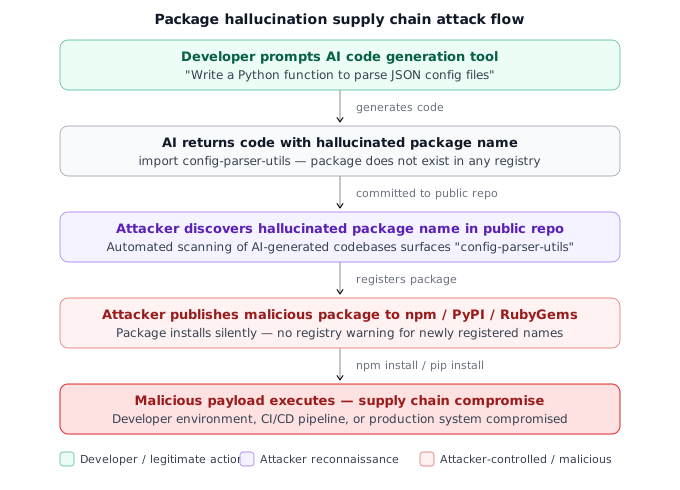
Package hallucination is one of the highest-severity risks in the AI code generation threat model and one of the most widely recognized by practitioners. When generating import statements or dependency declarations, models may fabricate package names that do not exist—or that do not exist yet.
The attack surface this creates is significant: a threat actor can monitor AI-generated code repositories for hallucinated package names, register those names in public package registries (npm, PyPI, RubyGems), and publish malicious packages under those names. Any developer who trusts and installs the AI-suggested dependency installs the attacker’s payload.
This is a supply chain attack enabled by AI hallucination, and it requires:
- Dependency verification before any AI-suggested package is installed
- Private package mirrors or allow-lists that prevent installation of unvetted packages
- SCA tooling that flags newly introduced dependencies for review
PoC: Package Hallucination Attack Chain
Package Hallucination: AI Code Generators Referencing Non-Existent Dependencies
AI models fabricate import statements for packages that don’t exist, enabling attackers who monitor AI-generated repos to register those names in public registries with malicious payloads—delivering a supply chain attack at the moment a developer runs npm install or pip install.
Proof of Concept Steps / Technical Write-up:
-
The hallucination mechanism: AI models generate code by predicting statistically plausible token sequences. When generating an import statement or dependency declaration, the model may produce a package name that sounds plausible—syntactically correct, semantically coherent—but refers to a package that does not exist in any public registry.
-
The attack surface — dependency squatting: Once a hallucinated package name appears in a codebase (even in a branch, pull request, or fork), a threat actor monitoring AI-generated repositories identifies the non-existent name and registers it in the target registry (npm, PyPI, RubyGems, Maven Central). The actor then publishes a malicious package under that name.
-
Silent installation: Any developer or CI/CD pipeline that subsequently runs
npm install,pip install, or equivalent installs the attacker’s payload without any warning. The package exists, it installs successfully, and nothing in the standard dependency resolution flow flags it as malicious. -
Scale amplification: Across an organization with hundreds of developers each generating dozens of import suggestions per day, the volume of candidate hallucinated package names that threat actors can monitor scales directly with AI adoption.
-
Detection gap: Current AI code generation tools do not natively flag when a suggested package name does not exist at the time of generation. The developer sees a syntactically correct import and must independently verify it. Most developers, under time pressure, do not perform this check for every suggestion.
-
Required controls: Automated dependency verification gate in CI/CD; allow-list enforcement preventing installation of unapproved packages; SCA tooling flagging newly introduced dependencies; private package mirrors routing resolution through vetted packages only.
Risk 3: Poorly Optimized Code
AI-generated code is not necessarily bad code, but it is not guaranteed to be optimized code. The model generates what is correct and statistically common—not what is most performant for your specific workload. Key observations:
- Generated code may be functionally correct but inefficient at scale
- If you do not ask for performant code explicitly, you may not get it
- Iterative prompting to optimize generated code often produces results better than what an average developer would produce
For security engineers, poorly optimized code carries a secondary risk: resource exhaustion and denial-of-service conditions arising from inefficient loops, unbounded queries, or missing pagination are exploitable.
Risk 4: Confidentiality and Data Exposure
When developers use cloud-hosted AI code generation tools, their source code is transmitted to external LLM endpoints. For open-source projects this is generally acceptable. For proprietary codebases, this creates material confidentiality risk.
An audience member raised this concern directly in the context of Aider[6]—an open-source AI coding assistant that sends code diffs to external APIs. The risk dimensions are:
- Proprietary algorithms and business logic leaving the perimeter
- Hard-coded credentials, API keys, or secrets in snippets sent for completion
- Internal architecture details exposed to third-party model providers and potentially used in future training data
Mitigations include:
- DLP tooling to inspect code before external transmission
- Local/self-hosted LLMs (e.g., Llama[7]) that keep source code entirely on-premises—trading data control for significant hardware cost
- Enterprise agreements that contractually prohibit vendors from using submitted code for model training
Risk 5: Developer Over-Reliance and Skill Degradation
A longer-horizon risk is the effect of sustained AI code generation use on developer capability. If developers routinely accept AI suggestions without deeply understanding the code, security intuition degrades over time.
The counterargument raised in the audience is valid: AI tools can explain code, and the documentation quality of AI-generated code often exceeds what a typical contractor produces. The tool can function as a learning aid as much as a crutch. But this requires intentional policy—teams must require developers to understand and validate suggestions rather than blindly accept them.
Risk 6: Technical Debt Amplification
AI code generation can increase technical debt if adoption is not governed carefully:
- Subtle bugs go undetected when generated code is not rigorously tested—AI does not flag its own errors
- Code quality degrades for complex scenarios: for simple, well-documented patterns the output is high quality; for domain-specific requirements, generated code may need multiple correction cycles
Risk 7: Infrastructure as Code Immaturity
AI code generation tools are significantly less mature for Infrastructure as Code than for application code. An audience member specifically observed that IaC suggestions contained more errors and required more correction cycles than application code generation.
This matters because misconfigured infrastructure—IAM policies, network security groups, storage bucket permissions—is a primary source of cloud security incidents.
PoC: Infrastructure as Code Immaturity in AI Code Generation Tools
Infrastructure as Code (IaC) Immaturity in AI Code Generation Tools
AI code generation tools are materially less mature for IaC than for application code, producing more misconfiguration errors that are caught at security review rather than earlier in the pipeline—creating a miscalibration risk when teams apply the same trust level to AI-generated IaC as to application code.
Proof of Concept Steps / Technical Write-up:
-
The quality gap: AI models are trained primarily on application code, which vastly outnumbers IaC in public repositories. IaC is also more provider-specific, more version-sensitive (Terraform 0.12 vs. 1.x syntax differences), and more contextually dependent. These characteristics make IaC harder for models to generate correctly.
- The security risk surface of misconfigured IaC: AI-generated IaC is most likely to produce insecure defaults in:
- IAM policies with wildcard permissions (
*) where scoped permissions are required - Storage buckets (S3, Azure Blob, GCS) configured with public access
- Network security groups with
0.0.0.0/0ingress on sensitive ports - Missing encryption at rest or in transit for databases, volumes, and object storage
- Disabled logging and monitoring (CloudTrail, VPC Flow Logs, audit logging)
- IAM policies with wildcard permissions (
-
Detection lag: The audience member reported that some AI-generated IaC errors were caught at the security review stage rather than during development or automated scanning. In organizations without mandatory security review for IaC, these errors would reach production.
- Required compensating controls:
- Mandatory security-focused review for all AI-generated IaC, separate from general code review
- IaC-specific static analysis (Checkov[8], tfsec[9], cfn-nag) integrated into CI/CD
- Explicit security constraints in IaC prompts: include encryption, access blocking, and logging requirements as default prompt context
- Least-privilege review for all AI-generated IAM policies before deployment
- Policy as Code enforcement (OPA, AWS Config) preventing non-compliant infrastructure deployment regardless of generation source
Actionable Takeaways
- Treat AI-generated code as untrusted input: keep SAST, DAST, and SCA tooling fully active in your pipeline and resist any pressure to reduce security scanning because "AI already checked it." AI tools catch common vulnerability classes but consistently miss context-specific and niche security requirements.
- Establish a mandatory dependency verification step for any package introduced via AI suggestion—cross-reference against your organization's approved package allow-list before installation to eliminate the package hallucination supply chain attack surface.
- Assess your confidentiality risk before deploying cloud-hosted AI tools: inventory what categories of source code are transmitted to external endpoints, apply DLP controls to prevent secrets and proprietary logic from leaving the perimeter, and evaluate whether self-hosted LLM options are warranted for your most sensitive codebases.
Common Pitfalls
- Reducing regression testing, integration testing, or security scanning cadence after AI code generation adoption, on the assumption that AI-generated code is cleaner than human-written code—this directly enables undetected bugs and vulnerabilities to reach production at higher velocity than before.
- Allowing developers to install AI-suggested packages without verification, effectively treating the model's hallucinated or suggested dependency list as a trusted source—this is the primary attack vector for AI-enabled supply chain compromise.
Copyright, Licensing, and IP Liability in AI-Generated Code
Why IP Liability Is a Security Engineering Concern
Copyright and licensing risk sits at the intersection of legal, compliance, and security—and AI code generation security risks in this domain cannot be handed off entirely to legal counsel. Understanding the exposure helps you design the governance controls that reduce it.
The Core Legal Question: Is Generated Code Derivative Work?
AI code generation models are trained on code scraped from public repositories and, in some cases, proprietary codebases. When a model produces a suggestion, that suggestion is statistically derived from its training corpus. The unresolved legal questions are:
- Is the generated code a derivative work of the copyrighted code it was trained on?
- Does using copyrighted code to train a model constitute fair use, or does it create downstream liability for outputs?
- What license governs the generated output? If a model was trained on GPL-licensed code, does the output carry GPL obligations?
There have not yet been definitive court rulings on these questions in most jurisdictions. Organizations should not assume silence means safety.
PoC: Samsung IP Lawsuit Scenario — Using Source Code Annotation to Prove AI-Generated Lineage
Samsung IP Lawsuit Scenario: Using Source Code Annotation to Prove AI-Generated Lineage
If an AI tool trained on proprietary Samsung source code generates a suggestion that mirrors Samsung’s implementation, and a developer commits it to production, Samsung can file a copyright infringement claim. Whether the organization can defend itself depends almost entirely on whether they have source code annotation proving the code came from the AI tool and not from Samsung directly.
Proof of Concept Steps / Technical Write-up:
-
Training data exposure: An AI code generation tool is trained on a corpus that includes proprietary Samsung source code—whether obtained through a public repository leak, scraping, or another channel. The model encodes statistical patterns from this code into its weights.
-
Developer accepts the suggestion: A developer receives a suggestion that mirrors the logic or structure of Samsung’s proprietary implementation. The suggestion looks reasonable, passes surface-level review, and is committed to production. No attribution is provided by the tool.
-
Samsung identifies the similarity: Samsung’s legal team or an automated IP monitoring system identifies that code in the target organization’s product closely mirrors proprietary Samsung implementations and files a copyright infringement claim.
-
The defense problem — no annotation: The organization must demonstrate the code came from the AI tool, not from Samsung’s codebase. Without source code annotation—metadata recording the AI engine, model version, developer, and timestamp at commit time—they cannot prove provenance. The absence of annotation transforms a defensible situation into an indefensible one.
-
The defense with annotation: An organization that enforces mandatory annotation can show: “Generated by GitHub Copilot (model version X.Y), accepted by [developer], committed on [date].” This evidence demonstrates AI-tool origin, allows invocation of the vendor’s IP indemnification clause, and provides a clear legal lineage trail.
-
Residual risk — vendor solvency: If the same tool generated infringing code across 15 customer organizations simultaneously, and those 15 organizations all invoke their indemnification clauses, a smaller vendor with $10–50M in reserves may face insolvency before all claims are resolved. Each organization’s contractual protection becomes a paper promise.
Key outcome: Annotation + enterprise indemnification from a financially stable vendor = defensible position. No annotation = defenseless regardless of indemnification coverage.
PoC: Enterprise License IP Indemnification and the Risk of Vendor Insolvency Under Multiple Lawsuits
Enterprise License IP Indemnification and Vendor Insolvency Risk
An audience member confirmed their organization purchased an enterprise license specifically for its IP indemnification clause. The speaker then surfaced the critical caveat: indemnification is only as good as the vendor’s capacity to pay it out under simultaneous multi-party litigation.
Proof of Concept Steps / Technical Write-up:
-
The indemnification model: Under an enterprise agreement, if a third party sues the organization for copyright infringement arising from AI-generated code, the vendor steps in as defendant or co-defendant, covers legal costs, and settles or litigates the claim. This works well in the single-plaintiff, single-defendant scenario.
-
The stress test — multi-party litigation at scale: The same tool generates infringing code across 15 customer organizations simultaneously. All 15 invoke their enterprise indemnification clauses. A vendor with $10–50M in reserves now faces the aggregate defense cost of 15 simultaneous lawsuits.
-
Vendor insolvency as the failure mode: If aggregate litigation costs exceed the vendor’s financial reserves, the vendor is rendered insolvent. Each organization’s indemnification contract becomes unenforceable against a bankrupt entity—leaving them to bear their own legal costs despite executing what appeared to be a complete risk transfer.
-
What organizations must assess:
- The vendor’s current financial reserves and funding runway
- The number of enterprise customers who would simultaneously invoke indemnification
- Whether the vendor has reinsurance or legal reserve structures to handle scale
- Whether migrating to a larger vendor (Microsoft/GitHub, Google, AWS) with substantially greater financial capacity is warranted for high-risk deployments
Source Code Annotation: Your Legal Lineage Trail
Source code annotation is the control that protects your organization when you need to prove what happened in court or during an audit. It means recording at commit time:
- Which AI engine generated the snippet (e.g., GitHub Copilot[1], Tabnine[2])
- Which model version was in use
- When the snippet was generated
- Which developer accepted and committed it
The talk notes that most organizations are not doing this yet, meaning most are building IP liability exposure with every AI-assisted commit. Annotation enforced at the tooling level—not left to developer discretion—is a low-cost, high-value control.
Licensing Filters
Some enterprise-tier tools allow configuration of training data filters—specifying that suggestions should only derive from permissively licensed code (MIT, Apache 2.0) and exclude copyleft (GPL) or proprietary code. When evaluating vendors, ask:
- Does the model offer permissive-only training data filters?
- Can you opt out of contributing your code to future training runs?
- What is the vendor’s data retention policy for submitted code?
Actionable Takeaways
- Require source code annotation as a mandatory workflow step for every AI-generated snippet committed to your repositories—record the AI engine, model version, developer, and timestamp at commit time so you have a defensible legal lineage trail before you need it.
- When selecting an enterprise AI code generation vendor, evaluate their financial capacity to honor IP indemnification commitments under multi-party litigation scenarios, not just the presence of an indemnification clause in the contract.
- Engage your legal and compliance teams before broad rollout to establish your organization's position on derivative work risk, training data license obligations, and the contractual terms you require from vendors.
Common Pitfalls
- Treating vendor IP indemnification as a complete risk transfer without assessing vendor financial stability—a startup vendor's indemnification clause is worth nothing if simultaneous multi-party litigation bankrupts them before your case is resolved.
- Deploying AI code generation at scale without source code annotation, assuming vendor indemnification alone is sufficient—annotation is your independent evidence trail and the one control entirely within your organization's control.
Mitigation Controls and Governance for AI Code Generation
Building a Governance Framework for AI Code Generation
Awareness of AI code generation security risks is only useful if it translates into controls. What follows is a structured governance framework organized by control type, drawn directly from practitioner experience in the talk.
Control 1: Establish a Written Code Generation Policy
The most fundamental control is a written, enterprise-wide code generation policy. Without policy, developers make individual decisions about what to accept, what to validate, and what to disclose—producing an inconsistent and unauditable security posture.
A code generation policy should specify:
- Permitted tools: which AI tools are approved for use and at which tier (enterprise only—no free tier in production)
- Permitted use cases: code completion, documentation, and test generation are generally lower risk than accepting large code blocks wholesale
- Prohibited behaviors: directly copying generated snippets without review; using free-tier tools for production code; sending code containing secrets or PII to external endpoints
- Annotation requirements: every AI-generated snippet committed must be annotated with engine, model, developer, and timestamp
- Accountability: the developer who commits AI-generated code is fully responsible for its correctness and security
An audience member confirmed their organization operationalized exactly this model: AI-generated code is used as a guide, not a source—developers look at the suggestion to understand the pattern, then write their own implementation. This preserves developer understanding while capturing productivity benefits.
Control 2: Vendor Selection and Enterprise Licensing
Enterprise-tier licensing is a prerequisite for production deployment. Vendor selection should follow a structured evaluation:
- Define use cases and success criteria before evaluating vendors
- Require IP indemnification with assessment of vendor financial capacity
- Require annotation/lineage features as non-negotiable
- Assess model training data licensing filters (permissive-only options)
- Review vendor data retention and training policies for submitted code
- Monitor vendor product roadmap and regulatory engagement
Control 3: Review and Testing — Never Skip Validation
The talk is unambiguous: always review and test generated code. The specific controls to expand when AI code generation is in use:
Code Review
- All AI-generated code in critical or client-facing applications must go through senior developer code review before merge
- Reviewers must treat AI-generated code with deeper scrutiny than human-written code—reviewers who assume it is pre-validated will miss issues
Integration and Functional Testing
- Integration testing and functional testing must be expanded when AI code generation is adopted, not maintained at existing levels
- AI tools improve test coverage significantly (test generation is one of their strongest use cases), but they cannot substitute for integration testing against real systems
- The best mental model: AI is a junior developer who knows too much—you still need reviews and tests; you just get faster drafts
Security Scanning
- SAST, DAST, and SCA must remain fully active in the pipeline—do not reduce scanning frequency because AI is generating code
- SCA is particularly important for catching hallucinated or unexpected dependencies before installation
Regression Testing
- Essential to catch cases where AI-generated code introduces subtle behavioral changes, especially where context window limitations cause suggestions that contradict existing patterns
Control 4: Phased Pilot Rollout
Do not begin AI code generation adoption on your most business-critical or client-facing applications:
- Select a small pilot group — experienced developers who understand the risk surface
- Start with low-risk applications — internal tools, non-critical services, or greenfield projects
- Define measurable success criteria — defect rates, code review findings, test coverage changes, productivity metrics
- Expand scope only after validation — once governance controls are proven, expand to broader developer populations
Control 5: Prompt Engineering Discipline
The quality of AI-generated code is directly proportional to the quality of the prompt. From a security perspective, this is a control surface:
- Prompts should include security context explicitly: instead of “write a user authentication function,” specify bcrypt hashing, rate limiting, event logging, and prohibition on hardcoded credentials
- Prompts should specify what not to do: excluding insecure patterns reduces the probability of generating them
- Security requirements must be stated in the prompt, not assumed—the model does not know your threat model
- For complex security-sensitive code, plan for multiple iteration cycles—the first response will rarely be optimal
Teams should develop prompt templates for common security-sensitive patterns (authentication, authorization, input validation, cryptography) that encode security requirements as default context.
Control 6: Source Code Annotation for Legal Lineage
From a governance perspective, annotation is also an audit and accountability mechanism:
- Security incidents can be traced back to specific AI-generated commits
- Compliance auditors can verify AI-generated code went through required review
- Metrics on tool usage, acceptance rates, and defect rates become available for program governance
Annotation should be automated—manually tagging AI-generated code is unreliable. Select tools with native annotation features or integrate annotation into CI/CD via pre-commit hooks.
Control 7: Dedicated Firewall / Isolated Pilot Environment
For organizations experimenting before committing to enterprise licensing, use a siloed pilot environment with a dedicated firewall—restricting AI tool access to a controlled set of users and codebases. This also limits confidentiality exposure: only pilot-scope code reaches external LLM endpoints.
Control 8: Monitor Adoption, Tooling Health, and Industry Signals
Ongoing monitoring should cover:
- Tool adoption metrics: usage rates, acceptance rates, developer satisfaction, defect rates from AI-generated vs. human-written code
- Security findings: track SAST/SCA findings attributable to AI-generated code over time
- Vendor health: monitor vendor news, breach disclosures, and financial signals
- Regulatory developments: AI code generation is an evolving regulatory space—organizations engaged early will have warning before compliance requirements become mandatory
The Governance Stack
| Layer | Control |
|---|---|
| Policy | Written code generation policy with explicit permitted/prohibited behaviors |
| Vendor | Enterprise licensing with IP indemnification; annotation features required |
| Development | Prompt templates; mandatory review; no blind copy-paste |
| Testing | Expanded integration, regression, and security scanning; SCA for dependencies |
| Legal | Source annotation for lineage; DLP for external transmission |
| Rollout | Phased pilot on low-risk applications before broad adoption |
| Monitoring | Usage metrics, security findings, vendor health, regulatory signals |
Actionable Takeaways
- Publish a written code generation policy before any AI tool reaches production—specify permitted tools and tiers, annotation requirements, prohibited behaviors (no free-tier in production, no secrets in prompts), and explicit developer accountability for committed code.
- Expand integration testing and security scanning when AI code generation is adopted—do not reduce existing controls. Treat the increased code generation velocity as a reason to invest more in automated testing infrastructure, not less.
- Develop security-aware prompt templates for common sensitive code patterns (authentication, authorization, input validation, cryptography) that encode your organization's security requirements as default context, reducing the probability of AI generating insecure patterns for those use cases.
Common Pitfalls
- Starting AI code generation adoption with business-critical or client-facing applications rather than a controlled pilot on low-risk scope—this maximizes blast radius if governance gaps are discovered and creates pressure to cut corners on validation to meet delivery timelines.
- Treating prompt quality as a developer preference rather than a security control—vague prompts consistently produce code that omits security requirements, and without explicit prompt templates, security is the first thing dropped from AI-generated code under time pressure.
Developer Accountability, AI Agents, and the Future of Secure AI-Assisted Development
Who Is Responsible for AI-Generated Code?
The accountability question is one of the most actively debated aspects of AI code generation adoption, and the transcript surfaces a rich audience discussion that reflects genuine uncertainty across the industry.
The Current Position: Developer Accountability Is Non-Negotiable
The talk’s position is unambiguous for current AI-assisted development tools:
The developer who commits the code is responsible for it.
It does not matter whether the code was written by hand, generated by GitHub Copilot[1], copied from Stack Overflow, or produced by ChatGPT[10]. If you are paid as a developer, you own what you commit. This position has direct implications:
- Code review cannot be relaxed because AI generated the code—reviewers are accountable for what they approve
- Developer training must include AI tool usage—accepting suggestions without understanding them is a skill and policy gap
- Accountability policies must be explicit in the code generation policy—ambiguity creates the conditions for blame-shifting after an incident
An audience member asked whether developers might deflect blame to the AI tool after an incident. The consensus: the developer pressed the commit button. The tool being company-approved does not transfer professional responsibility.
The Emerging Challenge: Agentic AI Workflows
The accountability model becomes significantly more complex with autonomous AI agents—systems that write, test, and commit code with minimal human review.
Key observations from the audience discussion:
- When a human accepts a Copilot suggestion, the human is clearly in the loop and accountable
- When an AI agent autonomously generates, reviews, and commits code, the human accountability chain is attenuated
- In a multi-agent architecture (manager agent → coding agent → review agent), tracing responsibility for a defect requires understanding which agent made which decision and whether a human had a meaningful opportunity to intervene
- Today’s code review practices—designed for human-written code reviewed by human peers—are not adequate for agent-generated code
The same mitigation philosophy applies: just as we have code reviews for human-written code, we should have review agents or automated review layers specifically designed for AI-generated code. For security engineers, governance frameworks built today should be designed to accommodate agentic workflows—not just human developers using AI suggestion tools.
Observed Technical Limitations
Token context window limits
AI models have finite context windows. For large codebases:
- The model cannot see the full codebase when generating suggestions
- Security controls in one part of the codebase are invisible to the model when generating code in another part—leading to inconsistent application of security patterns
- Workaround: break tasks into smaller, focused prompts; explicitly state security requirements that exist elsewhere in the codebase
Multi-iteration requirements for complex code
For complex or non-standard scenarios, the first AI response is rarely production-ready. Practitioners confirmed needing multiple prompt iterations to get correct, secure, performant output. AI code generation accelerates easy problems while still requiring expert guidance for hard ones.
Infrastructure as Code immaturity
Already covered in Section 2—apply heightened scrutiny to all AI-generated IaC until tool maturity improves. Security engineers should not rely on AI suggestions for security-sensitive IaC patterns.
What Skills Remain Essential
The more useful framing for security engineers is not whether developers will be replaced, but what skills remain essential as AI handles more mechanical code generation:
- Security reasoning and threat modeling — AI does not understand your threat model; humans must specify security requirements
- Code review judgment — evaluating whether AI-generated code is actually correct and secure requires deep technical understanding
- Incident response and debugging — AI agents that fail in production need humans who can trace the failure chain
- Architecture and design — AI generates implementations; humans determine what to implement and why
The consensus: AI as a junior developer who knows too much is the right mental model. Productive, fast, occasionally wrong, and always requiring review.
Actionable Takeaways
- Establish explicit accountability language in your code generation policy now—before agentic workflows arrive—stating that the developer or team responsible for a commit owns its security and correctness regardless of what generated it. This closes the blame-shifting gap before incidents create pressure to find it.
- Apply heightened security review to all AI-generated IaC (Terraform, CloudFormation, Kubernetes) until tool maturity improves—specifically review IAM policies, network security group rules, and storage configurations that AI tools are most likely to misconfigure.
- Treat context window limitations as a security control gap: when AI-generated code is added to a large codebase, explicitly verify it is consistent with the security patterns and controls already in place—the model cannot see what it cannot fit in its context window.
Common Pitfalls
- Assuming today's human-peer code review processes are adequate for agentic AI workflows—when AI agents write, test, and merge code autonomously, human review opportunities may be bypassed entirely, requiring purpose-built automated review layers rather than adapted human processes.
- Applying the same trust level to AI-generated IaC as to AI-generated application code—IaC generation is significantly less mature and misconfigured infrastructure has a much larger security blast radius than a bug in application logic.
Conclusion
AI code generation is not a risk to be avoided—it is a productivity multiplier that is already embedded in most engineering organizations, whether security teams have caught up or not. The security engineering mandate is clear: get ahead of the governance gaps before they become incidents.
The framework this talk delivers is practical and actionable today. A written code generation policy, mandatory source annotation, enterprise-tier licensing with IP indemnification, expanded testing at every layer, and prompt engineering discipline are not futuristic governance aspirations—they are controls you can implement this quarter. The package hallucination attack vector and the IaC maturity gap are risks you can close with tooling changes this sprint.
For the longer-horizon challenge of agentic AI workflows, the principle is the same one that has governed application security for decades: review everything before it reaches production, establish clear ownership, and design governance frameworks that are robust to the threat model of tomorrow, not just today’s.
Explore related talks on secure SDLC practices and software supply chain security for complementary coverage of the controls discussed here.
References & Tools
- GitHub Copilot — AI code generation tool by Microsoft/GitHub; primary example throughout for enterprise pricing, IP indemnification, and annotation requirements. ↩
- Tabnine — AI code completion tool with enterprise licensing; cited as an example of a smaller vendor where financial capacity to sustain indemnification under multi-party litigation is a concern. ↩
- AWS CodeWhisperer — Amazon's AI code generation offering; listed as part of the vendor landscape organizations are actively evaluating. ↩
- Google Codey / Gemini Code Assist — Google's AI code generation product; mentioned in the vendor landscape overview. ↩
- Codium — AI-powered code integrity tool; included in the vendor landscape as part of the active market. ↩
- Aider — Open-source AI coding assistant; cited by an audience member as an example of the confidentiality risk when proprietary source code is transmitted to external LLM APIs. ↩
- Meta Llama — Open-source LLM family referenced as a self-hosted option to mitigate confidentiality risk by keeping source code on-premises. ↩
- Checkov — Open-source IaC static analysis tool; recommended as a compensating control for AI-generated IaC to detect misconfiguration before deployment. ↩
- tfsec — Terraform static analysis security scanner; recommended alongside Checkov for detecting insecure defaults in AI-generated IaC. ↩
- ChatGPT / OpenAI — Referenced in context of developer accountability (committing ChatGPT-generated code does not transfer responsibility to OpenAI) and iterative prompt engineering for complex code. ↩
Questions from the audience
Related deep dives
Breaking AI Agents: Exploiting Managed Prompt Templates to Take Over Amazon Bedrock Agents
When Passports Execute: Exploiting AI Driven KYC Pipelines | [un]prompted 2026
Agents Exploiting Auth-by-One Errors | [un]prompted 2026