An adversary discovers a prompt injection that reliably overrides system instructions in one of your AI products. Within hours, the same attack — and dozens of slight variations — is hammering every LLM-powered service in your portfolio. This is the cross-service prompt injection problem at scale, and AI fingerprinting for cross-service prompt injection detection is the defense that most enterprise security teams don’t yet have in place.
This post breaks down Binary Shield, a research system built by engineers at Microsoft that generates compact, privacy-preserving fingerprints of suspicious prompts and broadcasts them across an organization’s entire AI service suite. Security engineers will learn the four-step pipeline in full, understand the privacy-utility trade-off controlled by differential privacy’s epsilon parameter, and walk away with a concrete pattern for integrating a shared threat registry into a heterogeneous safety stack.
Key Takeaways
- You'll learn how to build a four-step AI fingerprinting pipeline — PII redaction, embedding generation, binary quantization, and differential privacy noise injection — that lets your organization correlate prompt injection attacks across multiple LLM services without exposing any user content.
- You'll be able to architect a cross-service threat registry that broadcasts attack fingerprints to all products in your suite, so a prompt injection caught by one service is automatically blocked by every other service, eliminating safety stack silos.
- Apply the epsilon-based privacy budget trade-off framework to tune your fingerprint noise level against your organization's compliance requirements, achieving 36x faster threat correlation than dense embeddings while maintaining meaningful detection accuracy.
The Cross-Service Prompt Injection Problem in Enterprise AI
AI fingerprinting for cross-service prompt injection detection addresses a structural gap that most enterprise AI security teams have not yet closed: when an organization runs multiple AI-powered services — separate copilots, assistants, and foundational model APIs — those services almost always operate in isolation from a security standpoint.
The Siloed Safety Stack Problem
Large organizations rarely have a single unified AI surface. Microsoft, as the talk’s presenters illustrate, runs products like Azure AI Foundry, GitHub Copilot, and Microsoft 365 Copilot as distinct services with distinct safety stacks. Each product may have been built by a different team, deployed in a different region, and hardened to a different compliance standard. The result is a patchwork of block lists, detection heuristics, and moderation layers that do not share signal with one another.
This divergence is not a failure of intent — it is an emergent consequence of real engineering constraints: development velocity, customer-specific requirements, and regulatory variation across deployment regions. Even in organizations with strong security cultures, the safety posture of any one product will drift away from the others over time.
Why Silos Create Systemic Risk
The structural vulnerability this creates is straightforward: if an adversary discovers a prompt injection that reliably overrides system instructions in one product, nothing stops that same attack — or minor variations of it — from being replayed against every other AI service in the portfolio.
Because the services share no threat intelligence, a detection event in Service A generates no defensive signal for Services B or C. An attacker who performs reconnaissance against a lower-sensitivity product can develop and refine their injection payload there, then spray it across the entire suite. The organization is, in effect, only as strong as its weakest AI product.
The presenters frame this as a cross-service threat correlation problem: the raw signal needed to connect related attacks exists, but it is locked inside per-service logs that cannot be shared directly. Sharing the actual prompt text between services is a non-starter — it exposes user content and violates privacy obligations. The challenge is correlating attacks across service boundaries without revealing what any individual user typed.
The Scale of the Exposure
A spray attack exploiting this gap can move quickly. Once a single effective prompt injection is identified, an adversary can propagate it to every service simultaneously. Services with weaker or outdated safety stacks will not catch it, and there is no automated mechanism to backfill the detection capability across the portfolio. Security teams are left in a reactive, whack-a-mole position: catching the attack in one place, then manually replicating the fix everywhere else — if they even realize the same attack is in play across multiple products.
This is the core threat model that Binary Shield is designed to close.
Actionable Takeaways
- Audit your organization's AI product portfolio and document the safety stack for each service. Identify which products share detection logic and which operate independently — the gaps between them represent your cross-service exposure surface.
- Treat a prompt injection caught in any one AI service as a portfolio-wide signal, not a single-product event. Until a cross-service correlation mechanism is in place, manually triage whether the same attack pattern could succeed against other services in the suite.
- When evaluating cross-service threat sharing solutions, confirm that any proposed mechanism strips personally identifiable information and does not transmit raw user prompts between services — privacy compliance is a hard constraint on the architecture, not an optional enhancement.
Common Pitfalls
- Assuming that a mature safety stack in one AI product provides coverage for the rest of the portfolio. Each service's block lists and detection logic diverge over time due to development velocity and differing customer requirements, creating detection blind spots that attackers can target selectively.
- Attempting to share raw prompt logs between services to enable threat correlation. This approach violates user privacy obligations and is specifically called out in the talk as infeasible — any cross-service intelligence system must operate on redacted or privacy-preserving representations of the original prompts.
The Binary Shield Fingerprinting Pipeline
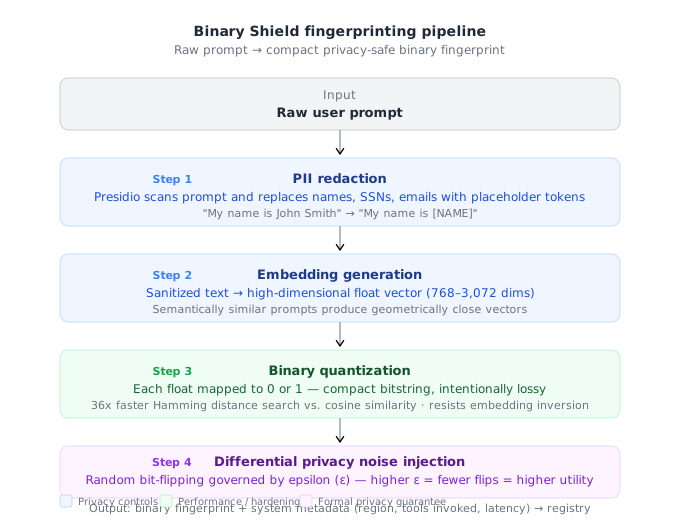
The core innovation in Binary Shield is a four-step pipeline that transforms a raw prompt into a compact, privacy-preserving binary fingerprint. Each step has a distinct security rationale, and together they create a one-way transformation that strips private information, retains semantic signal, and resists reverse engineering. This is the mechanism that makes AI fingerprinting for cross-service prompt injection detection operationally viable at enterprise scale.
Step 1: PII Redaction
Before any fingerprint is generated, personally identifiable information must be removed from the prompt. This is the foundational privacy control — you cannot share any derivative of a user’s prompt across services if that derivative can leak names, social security numbers, email addresses, or other identifying data.
In the Binary Shield implementation, the presenters use Presidio[1], an open-source PII detection and redaction library. The redaction process works by scanning the input text, identifying PII entities, and replacing them with placeholder tokens. For example, the phrase “My name is John Smith” becomes “My name is [NAME]” after redaction. The same pattern applies to SSNs, email addresses, phone numbers, and any other PII class Presidio is configured to detect.
Key implementation notes from the talk:
- Presidio is a practical default, but the presenters explicitly note that many alternative redaction libraries exist — teams should evaluate based on their compliance requirements and supported entity types.
- This step is a hard prerequisite. Skipping PII redaction and passing raw prompts downstream — even into embedding models — creates a data exposure path that would likely violate privacy regulations and internal data handling policies.
Step 2: Embedding Generation
Once the prompt is sanitized, it is fed into an embedding model to produce a high-dimensional floating-point vector that captures the semantic meaning of the text. This is the step that gives the fingerprint its fuzzy-matching capability — semantically similar prompts (e.g., two variants of “ignore all system instructions”) will produce vectors that are close together in the embedding space, even if the surface-level wording differs.
The Binary Shield implementation uses text-embedding-3-large from OpenAI[2], which produces vectors in the range of 768 to 3,072 dimensions depending on configuration. The presenters note that alternative embedding models can substitute here to reduce cost — the pipeline is not dependent on any specific provider.
The output of this step is a long list of floating-point numbers. These vectors are semantically rich but also large, expensive to store and search at scale, and — critically — potentially reversible. Dense floating-point embeddings retain enough information that a sufficiently motivated adversary might attempt to reconstruct approximate input text from the vector alone. This motivates Step 3.
Step 3: Binary Quantization
The third step compresses the floating-point embedding vector into a binary quantization representation — a list of zeros and ones. Every float is mapped to either 0 or 1 based on its sign or a threshold value, collapsing thousands of high-precision numbers into a compact bitstring.
This step serves two distinct purposes:
Efficiency: Binary vectors are dramatically faster to search and compare than dense floating-point vectors. Hamming distance — the number of bit positions where two binary strings differ — can be computed with a bitwise XOR operation, which is orders of magnitude cheaper than cosine similarity over floating-point vectors. The presenters report a 36x speed improvement in threat correlation searches compared to dense embeddings, measured across increasing corpus sizes.
One-way hardening: By intentionally discarding precision, binary quantization makes the pipeline more resistant to reverse engineering. The information loss is by design. An adversary who intercepts a binary fingerprint cannot reconstruct the original embedding with useful fidelity, and cannot recover the underlying prompt text. This is a deliberate security property of the transformation, not a side effect of compression.
The presenter’s framing is direct: “We’re intentionally losing information that’s kind of encapsulated by these long floating-point numbers to make it more difficult for an adversary to reverse engineer this pipeline and ultimately gain any private information from the users.”
Despite the information loss, binary quantization preserves enough semantic structure for attack correlation to work. The evaluation results shown in the talk demonstrate that binary fingerprints achieve accuracy approaching dense embeddings at sufficiently generous privacy budgets — the semantic signal needed to cluster related attack variants together survives the quantization step.
Step 4: Differential Privacy Noise Injection
The final step injects controlled noise into the binary fingerprint by randomly flipping bits according to a randomized mechanism governed by the epsilon (ε) parameter. This is the differential privacy component of the pipeline.
The epsilon parameter directly controls the privacy-utility trade-off:
- Large epsilon → fewer bits are flipped → low noise → high utility (accurate fingerprints) but weaker privacy guarantees
- Small epsilon → more bits are flipped → high noise → strong privacy guarantees but degraded detection accuracy
At the extreme, when epsilon approaches its minimum, the bit-flip probability approaches 50% — the resulting fingerprint is essentially random and provides no threat correlation signal. The presenters confirm this in their evaluation: at approximately ε = 0.5, detection accuracy drops to zero because nearly all bits have been randomized.
A critical implementation guidance point from the talk: do not hardcode or independently choose your epsilon value. The appropriate epsilon is a function of your organization’s regulatory environment, the sensitivity of the data your AI services process, and the detection accuracy your security operations require. The presenters explicitly recommend determining this value in close collaboration with legal and compliance teams, not by security engineering alone.
Attaching System Metadata
After the four pipeline steps, Binary Shield appends system metadata to the fingerprint package before broadcasting it. This metadata includes non-private operational context such as:
- The region where the query originated
- Which tools were invoked during query execution
- Query execution duration
This metadata is not derived from user content and does not go through the PII redaction and quantization steps. It provides additional signal for threat correlation — for instance, an attack pattern appearing in the same region across multiple services strengthens the confidence that the detections are related.
The Pipeline as a One-Way Transformation
Viewed end to end, the pipeline is designed as a one-way transformation with defense-in-depth privacy properties. Each step reduces reversibility:
- PII redaction removes identifying strings before any vectorization occurs
- Embedding generation encodes semantic meaning in a high-dimensional space that is not directly interpretable
- Binary quantization discards floating-point precision, preventing embedding inversion
- Differential privacy noise injection randomizes the bitstring, providing formal privacy guarantees against reconstruction attacks
The result is a fingerprint that is compact (a binary vector), fast to search (Hamming distance), semantically meaningful (clusters related attack variants), and privacy-safe enough to share across service boundaries.
Binary Quantization and Differential Privacy Applied to a Prompt Injection Fingerprint
Proof of Concept
-
PII Redaction — Take the raw prompt input and strip all personally identifiable information before any processing occurs. In the demo, a prompt containing “My name is John Smith” has the name replaced with a placeholder token. The same redaction applies to social security numbers, email addresses, and any other identifying fields. Presidio[1] is used in the reference implementation, though other redaction libraries are interchangeable. The output is a sanitized prompt string safe for downstream processing.
-
Embedding Generation — Feed the PII-redacted prompt text into an embedding model to produce a high-dimensional floating-point vector capturing the semantic meaning of the prompt. The reference implementation uses text-embedding-3-large from OpenAI[2], which outputs a long list of floating-point numbers (e.g., 768 or 3,072 dimensions depending on the model variant). These dense floats encode rich semantic relationships — two prompt injections that say “ignore all previous instructions” and “disregard your system prompt” will produce vectors that are geometrically close to each other. Alternative embedding models can be substituted to reduce cost.
-
Binary Quantization — Compress the high-dimensional floating-point embedding vector into a binary representation of zeros and ones. Each float dimension is reduced to a single bit, drastically reducing memory footprint and making the transformation intentionally lossy and one-way. The one-way property is critical: it becomes significantly harder for an adversary to reverse-engineer the original prompt text from the binary fingerprint, protecting user privacy even if the fingerprint is observed in transit or in the registry. Despite the precision loss, the binary representation retains sufficient semantic signal — high-dimensional embeddings (768+ dimensions) encode enough redundant information that the binary projection preserves meaningful clustering of related attack variants.
-
Differential Privacy Noise Injection — Apply controlled random bit-flipping to the binary vector using the differential privacy epsilon (ε) parameter to inject calibrated noise. When epsilon is large, very few bits are flipped — high utility, low privacy. When epsilon is small, many bits are randomly flipped — high privacy, low utility. At approximately ε = 0.5, so many bits are flipped that detection accuracy falls to 0%, providing strong privacy guarantees but no threat correlation signal. As ε increases, accuracy climbs back toward the performance of the original dense float embeddings. The epsilon value is not prescribed by the Binary Shield system — each organization must determine the appropriate value in collaboration with their legal and compliance teams, based on their regulatory environment and data sensitivity requirements.
-
Attach System Metadata — Append non-private system metadata fields to the fingerprint before broadcasting. These fields include contextual signals such as query execution time (latency), the geographic region the query originated from, and which tools were invoked during execution. This metadata enhances the fingerprint’s signal for cross-service correlation without adding any user-identifiable content.
-
Validate Fingerprint Similarity with Hamming Distance — Verify the pipeline is functioning correctly by comparing fingerprints of known-related and known-unrelated prompts using Hamming distance (the count of bit positions that differ between two binary vectors). In the demo, four prompts are fingerprinted: three variants of “ignore all system instructions” (original, variant 1, variant 2) and one benign prompt (“What is the weather in Seattle?”). The resulting distance matrix shows that the three attack variants produce fingerprints with low Hamming distance (lighter color, high similarity), while the benign prompt has high Hamming distance from all attack variants (darker color, low similarity). This confirms the fingerprint correctly clusters related attacks together while keeping dissimilar prompts distinct.
-
Performance Comparison — Confirm the 36x search speed advantage of binary fingerprints over dense float embeddings at scale. As the dataset size grows, dense embedding similarity search exhibits significant overhead. Binary vector search using Hamming distance scales dramatically better, achieving approximately 36x faster threat correlation lookups — critical for a cross-service registry that must perform real-time matching against a growing database of known attack fingerprints.
Actionable Takeaways
- Deploy PII redaction as the mandatory first step in any prompt fingerprinting pipeline — use Presidio or an equivalent library and configure it for all entity types relevant to your service's data handling obligations. Never pass raw or partially sanitized prompts into an embedding model that produces shareable outputs.
- Apply binary quantization to all fingerprints intended for cross-service sharing. The 36x search speed gain over dense embeddings is operationally significant at scale, and the intentional precision loss is a security feature — not a compromise — because it resists reverse engineering of the original prompt.
- Treat the epsilon parameter as a compliance decision, not an engineering default. Work with your legal and privacy teams to establish the acceptable noise level for your data classification and regulatory requirements before finalizing the differential privacy configuration.
Common Pitfalls
- Setting epsilon without legal and compliance input. Engineers who independently choose an epsilon value optimized purely for detection accuracy may inadvertently configure fingerprints that retain too much information to be safely shared across service boundaries under applicable privacy regulations. The presenters explicitly flag this as a risk and recommend organizational collaboration on the value.
- Treating binary quantization as a lossy shortcut rather than a security control. Teams that skip quantization and share dense floating-point embeddings across services preserve more detection signal in the short term, but expose themselves to embedding inversion attacks — a class of attacks where an adversary reconstructs approximate input text from the embedding vector. The information loss in binary quantization is intentional and should not be reversed to "improve accuracy."
Privacy-Utility Trade-offs with Differential Privacy and Epsilon Tuning
The fourth and final step of the Binary Shield pipeline introduces differential privacy — the mechanism that makes fingerprints safe to share across organizational boundaries. Understanding how to tune this step correctly is one of the most consequential decisions in any differential privacy in AI security deployment, and it sits at the intersection of engineering judgment, legal obligation, and threat model requirements.
What Differential Privacy Does in This Pipeline
After binary quantization produces a list of zeros and ones, differential privacy injects controlled noise into that bit vector by randomly flipping bits. The degree of flipping is governed by a single scalar value: epsilon (ε).
The relationship is direct and linear in its effects:
- High epsilon → few bits flipped → high utility, low privacy. The fingerprint closely resembles the original quantized embedding. Threat correlation accuracy is high, but an adversary with access to enough fingerprints could potentially infer information about the underlying prompts.
- Low epsilon → many bits flipped → high privacy, low utility. The fingerprint approaches random noise. User content is maximally protected, but the signal needed for threat correlation degrades — eventually to zero.
The Binary Shield evaluation data makes this trade-off concrete: at roughly epsilon = 0.5, detection accuracy drops to 0% because so many bits have been flipped that the fingerprints no longer retain meaningful semantic relationships. As epsilon increases toward higher values, accuracy recovers and approaches the performance of raw dense embeddings — confirming that the binary quantization step itself does not destroy the semantic signal needed for correlation.
Why Engineers Should Not Pick Epsilon Alone
The talk is explicit on this point: the presenters deliberately do not recommend a specific epsilon value. This is not a limitation of the research — it is a design principle. Epsilon is not a pure engineering parameter. It encodes a legal and organizational commitment about how much information can leak from a fingerprint before the disclosure violates user privacy guarantees.
The correct process for setting epsilon requires:
- Understanding your data classification. Prompts sent to AI services may carry personally sensitive content depending on the product and user base. The appropriate epsilon for a consumer-facing general assistant differs from one serving a medical or financial application.
- Engaging your legal and compliance teams. What level of differential privacy satisfies your organization’s contractual obligations, regulatory requirements (GDPR, HIPAA, CCPA), and internal data governance policies?
- Treating epsilon as a function of those outputs, not as a performance knob to be maximized for detection accuracy.
This framing reframes epsilon tuning from a technical optimization problem into a cross-functional governance decision — one that requires security engineering to bring the technical trade-offs to the table, not resolve them unilaterally.
Evaluating the Trade-off Empirically
The Binary Shield evaluation plots privacy budget (x-axis) vs. threat correlation accuracy (y-axis), giving teams a concrete tool for communicating this trade-off to non-technical stakeholders. The curve shows:
- A steep accuracy cliff as epsilon drops toward zero — the point at which near-maximum noise renders the fingerprint useless for correlation.
- A gradual accuracy plateau as epsilon increases — confirming that beyond a certain point, adding less noise does not yield proportionally large accuracy gains.
Security engineers implementing this system should generate a similar curve against their own data before committing to an epsilon value. Running this calibration on a representative sample of known-malicious and known-benign prompts allows the team to identify the epsilon range where utility remains acceptable before presenting options to legal and compliance for a final decision.
The Privacy Budget Refreshment Question
One attendee raised the question of privacy budget consumption: each fingerprint generated consumes some of the epsilon budget, and over time that budget depletes. The presenters acknowledged this as an open area and noted that the core system varies epsilon and observes the utility implications, but does not prescribe a specific budget renewal strategy. This is consistent with differential privacy literature, where composition theorems govern how budget degrades across multiple queries — a consideration that production deployments will need to address explicitly, likely in consultation with privacy engineering specialists.
Actionable Takeaways
- Do not treat epsilon as a performance tuning knob. Before deployment, engage your legal and compliance teams with the empirical accuracy-vs-privacy curve for your specific data to determine an organizationally appropriate epsilon value that satisfies both regulatory requirements and operational threat detection needs.
- Build a calibration dataset of known-malicious and known-benign prompts representative of your product's traffic, then generate a privacy budget vs. accuracy curve. Use this curve as the artifact for cross-functional discussions — it translates an abstract parameter into a concrete operational decision.
- Plan for privacy budget management from the start. Each fingerprint generation consumes epsilon budget under differential privacy composition rules. Work with privacy engineering specialists to establish a budget refresh or accounting strategy before the system reaches production scale.
Common Pitfalls
- Setting epsilon based solely on maximizing detection accuracy without consulting legal and compliance. A high epsilon that achieves excellent threat correlation may still violate your organization's privacy obligations or regulatory requirements. The engineering team should present the trade-off curve, not make the final call.
- Assuming a universal epsilon recommendation exists. The Binary Shield researchers deliberately withheld a default value because the right epsilon is context-dependent — it varies by product type, data sensitivity, user base, and jurisdiction. Copying an epsilon value from a research paper or another organization's deployment without this analysis is an anti-pattern.
Cross-Service Threat Registry Architecture and Integration
The Divergent Safety Stack Problem
Any organization running more than one AI-powered product will eventually face a structural drift problem: each product team ships features at its own pace, serves different customer segments, and operates under different regulatory constraints. The result is that safety stacks diverge. One product may have a curated block list for known prompt injection patterns; another may rely entirely on a fine-tuned classifier; a third may have no specialized prompt injection defense at all. In isolation, each might be “good enough.” But when an adversary finds one effective attack variant and sprays it across the entire portfolio, the weakest service becomes the entry point — and there is no mechanism for the service that caught the attack to warn the others.
This is the core architectural gap that cross-service threat intelligence addresses. Binary Shield’s registry model is designed specifically for this environment: heterogeneous services, different safety capabilities, and a shared attack surface.
The Registry Pattern: Publish, Broadcast, Block
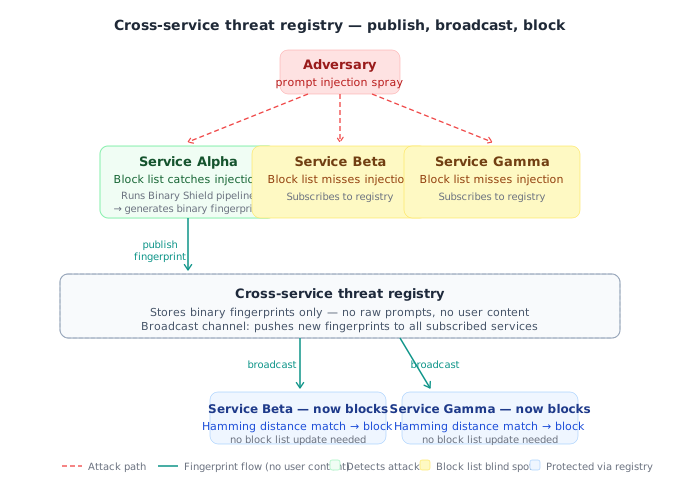
The registry operates on a straightforward publish-subscribe model:
- Detection event: A service catches a malicious prompt — in the demo, Service Alpha detects a variant of the “ignore all previous instructions” prompt injection because its block list includes that specific pattern.
- Fingerprint generation: Service Alpha runs the four-step Binary Shield pipeline on the detected prompt — PII redaction, embedding, binary quantization, differential privacy noise injection — producing a compact binary fingerprint.
- Registry publish: Service Alpha publishes the fingerprint to a central registry. Critically, only the fingerprint is shared, never the raw prompt or any user content. The prompt itself stays within Service Alpha’s privacy boundary.
- Broadcast to all services: The registry pushes the fingerprint to every other service in the suite — in the demo, Service Beta and Service Gamma.
- Block on match: When either of those services subsequently receives a prompt, they compute its fingerprint and check Hamming distance against the registry. If the distance falls below the configured threshold, the prompt is flagged — even if the incoming prompt is a slight variation the service’s own block list would never have caught.
The result: a single detection event propagates protection to the entire product fleet without any service needing to update its own detection logic, retrain its models, or coordinate a deployment.
Why the Demo Uses Three Different Block Lists
The demo deliberately constructs a worst-case scenario: three services (Alpha, Beta, Gamma) with three different block lists that catch different things. As Natalie explains, this is intentionally simplified relative to a real production environment, but it illustrates the key point. Service Alpha can catch “ignore all previous instructions.” Service Gamma cannot. Without a registry, Service Gamma is permanently blind to that attack class unless its operators manually update its block list — which requires them to know the attack exists and to prioritize the update against competing development work.
With the registry in place, the moment Service Alpha fires, Gamma gains the same effective protection without any change to Gamma’s own safety stack. The registry acts as a compensating control that raises the floor across all services simultaneously.
Cross-Service Attack Broadcast Demo: Service Alpha Detects, Beta and Gamma Block
Proof of Concept
-
Establish three services with different block lists — Three services — Alpha, Beta, and Gamma — are instantiated with distinct block lists to simulate the real-world condition where a multi-product organization’s safety stacks diverge over time due to different dev velocity, customer requirements, and regional regulatory constraints. The intentional mismatch is the starting vulnerability: Service Alpha’s block list includes the pattern “ignore all previous instructions,” while Service Beta’s and Gamma’s block lists do not.
- Prepare the prompt corpus — Four prompts are constructed for the test run:
- Original: A canonical prompt injection — a variant of “ignore all system instructions” designed to override intended LLM behavior.
- Variant 1: A slight textual perturbation of the original prompt injection (semantically equivalent, minor wording difference).
- Variant 2: A second slight textual perturbation of the original (another small wording change, same malicious intent).
- Benign: “What is the weather in Seattle?” — a clearly innocuous prompt used as a negative control to confirm the system does not over-block.
-
Feed all four prompts through all three services — Each of the four prompts is submitted to Service Alpha, Service Beta, and Service Gamma independently. This simulates an adversary spraying a prompt injection campaign across an organization’s full product suite.
-
Observe the detection gap — Only Service Alpha flags the original prompt injection and its variants as malicious. Service Beta and Gamma fail to detect them due to their incomplete block lists. The benign prompt passes cleanly through all three services, confirming the system does not trigger false positives on unrelated content.
- Service Alpha fingerprints the detected attack — Upon detecting the prompt injection, Service Alpha runs the four-step Binary Shield pipeline on the offending prompt:
- PII Redaction: Personally identifiable information is stripped from the prompt text using the Presidio[1] open-source library. A placeholder token replaces each redacted entity.
- Embedding Generation: The PII-redacted prompt is passed into the
text-embedding-3-largemodel from OpenAI[2], producing a high-dimensional floating-point vector that captures the semantic meaning of the prompt. - Binary Quantization: The floating-point embedding vector is compressed to a binary representation (zeros and ones). This compression reduces memory footprint, increases search speed, and makes the fingerprint intentionally one-way — information loss at this stage prevents adversaries from reverse-engineering the pipeline to recover private user content.
- Differential Privacy Noise Injection: Controlled random bit-flips are applied to the binary vector, governed by the epsilon parameter. A higher epsilon means fewer bit-flips (lower privacy, higher utility); a lower epsilon means more bit-flips (higher privacy, lower utility). The resulting noisy binary fingerprint, combined with system metadata (query region, tools invoked, execution latency), forms the complete Binary Shield fingerprint.
-
Broadcast fingerprint to the cross-service registry — Service Alpha publishes the binary fingerprint to the shared threat registry. The registry acts as the broadcast channel — all services in the organization’s product suite subscribe to it and receive newly published fingerprints in real time.
-
Service Beta and Gamma consume the fingerprint — Service Beta and Gamma receive the broadcast fingerprint from the registry. They now have the capability to match incoming prompts against this fingerprint using Hamming distance comparison — no changes to their underlying block lists or safety stack logic are required.
-
Verify downstream blocking — The next time the adversary submits the same attack prompt — or a small perturbation of it — against Service Beta or Service Gamma, the incoming prompt is fingerprinted on ingestion and its Hamming distance to the registry entry is computed. Because the distance falls below the similarity threshold (confirmed in the demo via the Hamming distance matrix showing attack variants cluster together with low distances), both services now block the prompt. The benign prompt remains far from the fingerprint in Hamming distance space and continues to pass through unblocked.
- Outcome — A single detection event in Service Alpha propagates defensive coverage to every other service in the suite within the broadcast cycle — without requiring a coordinated safety stack overhaul, cross-team engineering work, or exposure of raw user prompts between services. The attack surface for prompt injection spray campaigns is reduced structurally rather than reactively.
Integration Without a Safety Stack Overhaul
A key design goal of Binary Shield is that integration should not require teams to abandon or replace their existing safety infrastructure. Services add a fingerprint-generation step to their detection pipeline and subscribe to the registry. Their existing block lists, classifiers, and anomaly detectors continue operating exactly as before. The registry layer is additive.
This matters operationally. Requiring each product team to rebuild their safety stack to adopt a new threat-sharing system would face significant organizational friction — different roadmaps, different risk tolerances, different engineering bandwidth. Binary Shield sidesteps that by operating as an overlay: any service that catches anything now automatically contributes to and benefits from the shared threat intelligence fabric.
Handling Attack Variants Automatically
A question raised during the Q&A highlights an important property of this architecture: does the system require catching every variant of an attack individually, or does a single detection cover a family of related prompts?
The answer is the latter, and it follows directly from how the fingerprints are constructed. Because binary quantization and the Hamming distance threshold introduce fuzziness, a fingerprint does not match only verbatim replays — it matches prompts within a semantic neighborhood of the original. When an adversary generates small perturbations of a known-effective injection (changing word order, swapping synonyms, adding filler text), those variants will still fall within the Hamming distance threshold of the registered fingerprint.
The threshold itself is a tunable parameter. Security teams can widen it to catch a broader ring of variations at the cost of more false positives, or narrow it to be more precise at the cost of missing distant variants. This makes the registry architecture adaptive: as the threat landscape evolves and attackers refine their prompts, threshold tuning and re-registration of updated fingerprints allow the system to track the attack family rather than chase individual strings.
Operational Considerations for Registry Deployment
- Epsilon must be consistent across services. If different services apply different noise levels when generating fingerprints for the same prompt, Hamming distance comparisons between services will be unreliable. Organizations should establish a fleet-wide epsilon policy, developed in collaboration with legal and compliance teams, before deploying the registry.
- Registry trust boundaries. Since fingerprints are shared across service boundaries, the registry itself becomes a sensitive component. Access control, audit logging, and tamper detection on the registry are necessary to prevent an adversary from polluting the shared fingerprint store.
- False positive management. A fingerprint that is too aggressive (low epsilon, wide Hamming threshold) could cause legitimate prompts to be blocked fleet-wide. Monitoring false positive rates per service and per fingerprint is essential, especially in the early deployment phase.
Actionable Takeaways
- Implement the registry as an additive overlay, not a replacement: integrate Binary Shield's fingerprint generation and registry subscription into each service's existing detection pipeline without decommissioning current block lists or classifiers. This minimizes integration friction and allows gradual rollout across a heterogeneous product fleet.
- Establish a fleet-wide epsilon policy before deploying cross-service fingerprint sharing. Inconsistent noise levels across services will produce incomparable fingerprints and degrade Hamming distance matching. Involve legal and compliance teams early to set an epsilon value that satisfies privacy requirements while retaining sufficient detection utility.
- Tune the Hamming distance threshold deliberately and monitor false positive rates per service after deployment. Start conservative (narrow threshold, low false positive risk), then widen incrementally while tracking detection coverage against known attack variants to find the right operating point for your organization's risk tolerance.
Common Pitfalls
- Treating the registry as a passive log rather than an active broadcast system. The value of Binary Shield's architecture comes from pushing fingerprints to all services the moment an attack is detected, not from requiring services to periodically poll for new entries. A polling-based integration reintroduces the detection lag that the system is designed to eliminate.
- Using raw prompt content in cross-service communication instead of fingerprints. The entire privacy argument for Binary Shield rests on sharing only the binary fingerprint, never the underlying prompt. Any implementation shortcut that passes prompt text between services — even for debugging or logging — violates user privacy guarantees and likely regulatory requirements, and undermines the architecture's core value proposition.
Detection Performance and Semantic Robustness of Binary Fingerprints
Binary Quantization Retains Meaningful Semantic Signal
A common objection to binary quantization is that collapsing high-dimensional floating-point vectors into zeros and ones discards too much information to be useful for AI fingerprinting for cross-service prompt injection detection. The Binary Shield evaluations directly address this concern. Embedding models such as text-embedding-3-large[2] produce vectors with 768 dimensions or more — sometimes up to 3,072 in larger variants. Even after binary quantization, each fingerprint still encodes hundreds of bits of semantic information. The empirical result is clear: the binary fingerprints achieve detection accuracy that approaches the accuracy of the original dense floating-point embeddings, at a fraction of the computational cost.
The key insight is that semantic similarity is preserved at the bit-pattern level. Prompts that are semantically related — such as variations of the same prompt injection attack — produce binary fingerprints with low Hamming distances, meaning their bit patterns are close together. Prompts that are semantically dissimilar — such as a benign weather query versus a system-instruction override — produce fingerprints with high Hamming distances. This property is what makes the system viable for cross-service LLM threat intelligence: you do not need exact matches; you need fuzzy similarity matching, and binary vectors deliver that.
Hamming Distance as the Similarity Metric
The Binary Shield demo explicitly validated this using a four-prompt test set:
- Original — a canonical “ignore all system instructions” prompt injection
- Variant 1 — a minor rephrasing of the same attack
- Variant 2 — another small perturbation of the original
- Benign — “What is the weather in Seattle?”
A similarity matrix was computed over the fingerprints of all four prompts using Hamming distance (the count of bit positions where two binary vectors differ). The results confirmed the expected clustering behavior:
- The original, variant 1, and variant 2 all had low pairwise Hamming distances — visually rendered as lighter colors in the matrix — indicating their fingerprints are close together.
- The benign prompt had high Hamming distance from all three attack variants — rendered as darker cells — indicating its fingerprint is far from the attack cluster.
This clustering property means the system naturally catches spray attacks: an adversary who sends slight perturbations of one effective prompt injection will produce fingerprints that all fall within a detectable similarity radius of the originally flagged prompt. The detection threshold (Hamming distance cutoff) can be tuned to widen or narrow this radius depending on tolerance for false positives.
Hamming Distance Matrix Showing Fingerprint Similarity for Attack Variants vs Benign Prompts
Proof of Concept
- Define the prompt corpus — Create a list of four prompts for the experiment:
- Original: The canonical “ignore all system instructions” prompt injection.
- Variant 1: A rephrased version of the same prompt injection with minor wording changes.
- Variant 2: Another perturbation of the same attack intent with slightly different phrasing.
- Benign prompt: “What is the weather in Seattle?” — a normal, non-malicious user query with no semantic relationship to the attack prompts.
- Generate Binary Shield fingerprints for each prompt — Run each of the four prompts through the full four-step pipeline:
- Strip PII using Presidio[1] (step 1 — no PII present in these examples, so output is unchanged).
- Generate high-dimensional semantic embeddings using text-embedding-3-large from OpenAI[2] (step 2), producing long lists of floating-point numbers that capture semantic meaning.
- Apply binary quantization (step 3), collapsing the float vectors to binary strings of zeros and ones. This step intentionally discards precision to harden the pipeline against reverse engineering.
- Inject differential privacy noise controlled by epsilon (step 4), randomly flipping bits to add controlled randomness. For this demonstration, epsilon is set at a value that preserves meaningful utility.
-
Compute pairwise Hamming distances — For every pair of fingerprints in the corpus, calculate the Hamming distance — the count of bit positions where the two binary strings differ. A lower Hamming distance means the fingerprints are closer together (more similar); a higher distance means they are farther apart (more dissimilar). With a 768-dimension or higher embedding quantized to binary, there are hundreds of bit positions to compare.
-
Build the distance matrix — Arrange all four fingerprints as both rows and columns of a matrix. Each cell contains the Hamming distance between the row fingerprint and the column fingerprint. The diagonal (a prompt compared against itself) is zero. Visualize the matrix as a heatmap where lower distances render as lighter colors and higher distances render as darker colors.
- Interpret the results:
- Attack cluster (Original, Variant 1, Variant 2): The three prompt injection variants produce fingerprints with low pairwise Hamming distances — displayed as lighter-colored cells in the matrix. This confirms that semantically related prompts, even after perturbation, land close to each other in the binary fingerprint space.
- Benign separation: The benign prompt (“What is the weather in Seattle?”) produces a fingerprint with high Hamming distances from all three attack variants — displayed as darker-colored cells in the matrix row and column corresponding to the benign prompt. This confirms that semantically unrelated prompts remain well-separated and will not be falsely flagged as related attacks.
- Operational implication — fuzzy matching with a threshold — The matrix demonstrates that a deployed Binary Shield registry does not need exact fingerprint matches to correlate attacks. An operator sets a Hamming distance threshold: any incoming prompt whose fingerprint falls within that threshold of a known-malicious fingerprint triggers a block. The clustering behavior observed in the matrix means the system naturally catches small perturbations of a known attack (i.e., Variant 1 and Variant 2 are caught once Original is registered) without catching benign traffic. The presenter explicitly notes that the threshold can be widened to catch a broader range of variants if needed, giving operators a tuneable detection radius around each registered attack.
Privacy Budget vs. Detection Accuracy Trade-off
The differential privacy noise layer introduces a direct, measurable trade-off between privacy and detection accuracy. This is governed by the epsilon parameter, and the Binary Shield evaluation quantifies it empirically:
- Low epsilon (high noise): At approximately epsilon = 0.5, the system reaches 0% detection accuracy. This occurs because nearly all bits in the quantized embedding have been randomly flipped, destroying the semantic signal entirely. Fingerprints become effectively random noise — highly private but completely useless for threat correlation.
- High epsilon (low noise): As epsilon increases, fewer bits are flipped. Detection accuracy climbs toward the accuracy of unperturbed dense embeddings. The fingerprints retain their semantic clustering properties while still providing some privacy protection.
The graph presented in the talk (privacy budget on the x-axis, threat correlation accuracy on the y-axis) shows a smooth curve — not a cliff — meaning teams have genuine flexibility to select an operating point that balances their compliance requirements against their detection needs. This is why the presenters explicitly decline to recommend a specific epsilon value: the right setting is organization-specific and must involve legal and compliance teams.
36x Search Performance Advantage Over Dense Embeddings
Beyond accuracy, binary quantization delivers a major performance benefit in the similarity search step — the operation that actually matches an incoming fingerprint against the registry of known attack fingerprints.
The evaluation measured search time as corpus size increased (corpus size on the x-axis, search time on the y-axis). The results were decisive:
- Dense embeddings showed significant and growing search overhead as the corpus scaled, because comparing high-dimensional floating-point vectors is computationally expensive.
- Binary Shield fingerprints achieved 36x faster threat correlation at scale, because Hamming distance calculations over binary vectors are extremely fast — modern CPUs can compute them using hardware-accelerated bitwise XOR and popcount operations.
For enterprise deployments where a threat registry may accumulate thousands or tens of thousands of fingerprints over time, this performance gap is operationally significant. It means the fingerprint lookup can be done inline in a request path without introducing meaningful latency, rather than being relegated to an async batch process.
Fuzzy Matching Covers Perturbation Attacks Without Enumeration
A question raised during the talk addressed whether the system devolves into a whack-a-mole game — catching known prompts one at a time while attackers iterate variants. The answer is that the fuzzy matching property of Hamming distance inherently captures a neighborhood around each registered fingerprint, not just the exact fingerprint.
When an attacker introduces small perturbations to an effective prompt injection — changing a word, adding punctuation, or reordering phrases — the resulting prompt is still semantically similar to the original. The embedding model captures that similarity, and binary quantization preserves it at the bit level. The new fingerprint lands within Hamming distance of the original registered fingerprint and is therefore caught automatically, without the defender having to fingerprint each variant individually.
This is distinct from, but complementary to, proactively generating synthetic variants using language models. Both approaches reinforce each other: synthetic pre-seeding widens coverage before an attack is seen in production, while fuzzy matching handles the long tail of adversarial perturbations that no pre-generation effort will fully anticipate.
Actionable Takeaways
- When evaluating whether binary quantization retains sufficient semantic signal for your use case, run a Hamming distance matrix over a test set that includes known attack variants and benign prompts before deploying to production. If related attack prompts cluster with low Hamming distances while benign prompts remain distant, the quantization is preserving the signal you need.
- Set your Hamming distance similarity threshold deliberately rather than using a default. A tighter threshold reduces false positives but may miss heavily perturbed variants; a looser threshold widens coverage but increases noise. Calibrate this against your organization's false positive tolerance and the diversity of prompts your services receive.
- Use the 36x search performance advantage of binary fingerprints as a justification for inline (synchronous) threat registry lookups rather than async batch checks. Inline lookups allow you to block attack variants in real time rather than detecting them after the fact.
Common Pitfalls
- Treating epsilon as a purely technical parameter and setting it without input from legal and compliance teams. The Binary Shield presenters explicitly state that epsilon must be determined in collaboration with your organization's legal function based on data classification and regulatory requirements — engineers who set it unilaterally risk either over-sharing protected user data or rendering the system useless through excessive noise.
- Assuming that low detection accuracy at small epsilon values means the system is broken. At very low epsilon values, accuracy approaching zero is the expected and intended behavior — it reflects the privacy-first operating mode, not a bug. Confusion here leads teams to incorrectly conclude the system does not work when they have simply configured it for maximum privacy at the cost of utility.
Conclusion
Binary Shield addresses one of the most structurally underserved problems in enterprise AI security: the fact that prompt injection attacks can move freely across a portfolio of AI services that share no threat intelligence with each other. The four-step fingerprinting pipeline — PII redaction, embedding generation, binary quantization, and differential privacy noise injection — produces compact binary vectors that are fast to search, resistant to reverse engineering, and safe to share across service boundaries. The cross-service registry broadcasts attack fingerprints fleet-wide the moment any single service detects a threat, raising the defensive floor across all products simultaneously without requiring a coordinated safety stack overhaul.
The key decision point for any team implementing this system is the epsilon parameter. It is not a technical knob — it is an organizational governance decision that must involve legal, compliance, and privacy engineering. The empirical privacy-utility curve is the tool for making that decision concrete and communicable to non-technical stakeholders.
For security engineers building or evaluating LLM security controls in multi-product environments, Binary Shield’s architecture offers both a working reference implementation and a principled design pattern for closing the cross-service detection gap. The Jupyter Notebook published alongside the paper provides a starting point for teams that want to evaluate the approach against their own prompt corpus before committing to a production deployment.
For related coverage, see prompt injection defense techniques and AI security architectures for broader context on enterprise LLM threat models.
References & Tools
- Presidio — Open-source PII detection and redaction library used in step one of the Binary Shield pipeline to strip personally identifiable information from prompts. ↩
- text-embedding-3-large (OpenAI) — Embedding model used in step two to convert PII-redacted prompt text into high-dimensional floating-point vectors encoding semantic meaning. ↩
Questions from the audience
Related deep dives
Kinetic Risk: Securing and Governing Physical AI in the Wild | [un]prompted 2026
Securing Workspace GenAI at Google Speed | [un]prompted 2026
Glass-Box Security: Operationalizing Mechanistic Interpretability | [un]prompted 2026