Your next conference talk might be quietly leading your team astray — not through malice, but through the structural omissions that make how to learn from security conference talks a critical skill for any practitioner. Speakers are bound by NDAs, reputational risk, time constraints, and the desire to look smart on stage; what gets cut is almost always the organizational dysfunction, the vendor discount, or the three engineers who quietly maintain the system six months after the speaker left the company.
For security engineers trying to extract actionable signal from a sea of polished presentations, the stakes are high. This post breaks down why conference talks are always partial, how to diagnose hidden predicates in real-time, what good contextual disclosure looks like, and how to change the way you attend — and give — talks.
Key Takeaways
- You'll learn why conference talks systematically omit the organizational, contractual, and contextual factors that make an approach work — so you can stop cargo-culting architectures that were built for a company ten times your size.
- You'll be able to apply a five-question diagnostic framework to any conference talk to identify hidden predicates, outdated assumptions, and missing build-vs-buy context before you bring recommendations back to your team.
- Apply this to avoid wasting engineering cycles on complex homegrown systems — by entering every conference with a problem list and using talks as targeted answers rather than a buffet of new initiatives.
Why Security Conference Talks Are Always Incomplete
The central thesis of how to learn from security conference talks starts with an uncomfortable admission: nearly every conference presentation you attend is, to some degree, incomplete. Not because speakers are bad actors — but because the structural conditions of public disclosure make full honesty practically impossible.
Ramy McCarthy framed this by asking a room of practitioners to raise their hands if they had ever been fully honest in their public work — sharing the whole context, the whole truth, every time. Almost no hands stayed up. That moment captures the core problem: public security content is always partial, and learning to extract value from it requires understanding exactly why.
Legal and Contractual Constraints
The most concrete barrier to full disclosure is organizational. When you give a conference talk, you are almost always bound by contracts — NDAs, employment agreements, and PR sign-off processes. This means the rough edges are frequently off the table:
- Organizational dysfunction that drove a build decision cannot be named
- Vendor relationships — intro calls, discounts, contractual obligations — are invisible in the final presentation
- Failed experiments and tool teardowns are omitted if they reflect poorly on leadership or partners
Speakers who work in corporate security are, at some level, always presenting in service of themselves or their business. That constraint shapes what makes the final slide deck.
Reputational Incentives Push Toward Polish
Beyond legal constraints, there is a powerful social dynamic at work. Conference talks require CFP acceptance, and acceptance requires pitching something that sounds impressive. Once on stage, speakers want to look and sound competent — which creates systematic pressure against disclosing anything that “shines negatively” on themselves or their organizations.
This is not cynicism. It is human. But the effect is predictable: the rough edges get cut. What remains is the part of the story that worked — the elegant system, the clever detection, the successful program. What disappears is the three months of failure before it, the team that quietly rebuilt it afterward, or the vendor that did the same thing for a fraction of the cost.
Time Limits Create Forced Omissions
Even when a speaker wants to share full context, the format makes it structurally impossible. A 30- or 45-minute slot cannot contain the full mental model of a complex system someone spent two years building. Speakers must pick and choose — and the incentive is to highlight what seems most broadly applicable, most impressive, most likely to justify the audience’s time.
The problem, as McCarthy pointed out, is that what gets cut is often exactly the context you need to evaluate whether the approach is relevant to your organization. The predicates — the organizational conditions, the scale constraints, the existing infrastructure — are the first casualties of the time limit.
Selection Bias in What Gets Presented
There is also a subtler form of incompleteness: the selection of which talks get given at all. Speakers tend to give talks when an experience is fresh, when they are excited about what they built, and when it feels like a success worth sharing. The systems that failed quietly, got deprecated, or were replaced by a vendor product two years later rarely produce conference talks — because by then the speaker has moved on.
This creates a survivorship bias in the conference talk ecosystem. You are systematically more likely to hear about the cool distributed lambda inventory system than about the team that tried it, couldn’t maintain it, and bought a product instead.
Contrived Omissions vs. Structural Omissions
McCarthy drew a useful distinction between two types of incomplete talks:
Contrived omissions — cases where speakers know they are leaving something out and make a deliberate choice to do so. A talk about a break-glass access system that never addresses why the organization needed break-glass access in the first place. A multicloud talk that omits the M&A history that made multicloud mandatory. A build-vs-buy framing that never acknowledges the vendor discount that wasn’t available.
Structural omissions — cases where the speaker would happily share context if asked, but the format and incentive structure simply don’t accommodate it. These talks are not deceptive; they are just shaped by constraints the audience cannot see.
Both types produce the same outcome: a practitioner in the audience walks away with an incomplete picture and potentially copies an approach that wasn’t designed for their context.
The Implication for Practitioners
If public information in security is always partial — and this is nearly axiomatic given the constraints above — then the only rational response is to stop treating conference talks as authoritative recommendations and start treating them as starting points for deeper inquiry. The talk tells you something worked somewhere, under conditions you don’t yet fully understand. Your job as a practitioner is to uncover those conditions before you act.
Actionable Takeaways
- Before acting on any conference talk recommendation, explicitly list the organizational, contractual, and technical conditions you don't know about the speaker's environment — then decide whether those unknowns are disqualifying for your context.
- Approach talks that focus exclusively on technical achievement (a cool system, a novel tool) with heightened skepticism: ask what organizational or financial context would have been legally or reputationally difficult to disclose, and whether that context is load-bearing for the approach.
- When evaluating whether a talk is worth acting on, consider the timing: was this talk given immediately after the system was built? If so, there is no longitudinal evidence that it delivered value, scaled, or survived staff turnover.
Common Pitfalls
- Treating the absence of disclosed drawbacks as evidence that drawbacks don't exist. Speakers omit rough edges for structural reasons, not because the rough edges aren't there — assuming a polished talk describes a clean reality is the most common mistake practitioners make.
- Copying architectures or programs without investigating the inciting problem. Many conference talks are driven by a specific organizational constraint (a contractual obligation, a compliance requirement, a staffing quirk) that will never appear on a slide. If you don't know what problem the speaker was actually solving, you cannot evaluate whether it's your problem too.
The Hidden Predicates Behind Cool Security Architectures
When you attend a conference and watch someone walk through a brilliant security architecture decision, the temptation to replicate it is real. The talk is polished, the system is elegant, and the speaker clearly knows what they’re doing. What you almost never see is the hidden list of organizational, financial, and technical predicates that made that architecture necessary — or even possible — in the first place.
This gap between what’s presented and what’s required is not about deception. It’s structural. Speakers have limited time, contractual constraints, and a natural incentive to present their work as broadly applicable. But the result is that practitioners often walk away from conference talks planning to build systems that simply don’t fit their context.
Understanding the predicates behind a given architecture — the conditions that made it the right choice — is one of the most important security architecture decision-making skills you can develop.
Netflix Multicloud Identity Architecture — Why You Should Not Copy It
Proof of Concept
-
Understand what Netflix actually built. Netflix segments identity into one AWS account and compute into a separate account, with data living in yet another account. This tripartite separation is a real architectural pattern that Netflix has presented publicly alongside AWS. It is not theoretical — it is a documented, production architecture.
- Identify the predicates that made this necessary for Netflix. The speaker explicitly enumerates three conditions that drove this architecture:
- 10 years of data gravity — Netflix has accumulated a decade of resources, configurations, and dependencies that cannot be easily reorganized. Their architecture reflects that constraint.
- Account service limit exhaustion — Netflix operates at a scale where the number of AWS resources in a single account starts hitting AWS service limits. Segmenting by function (identity vs. compute vs. data) is a structural workaround for limits most organizations will never reach.
- Legacy systems already in place — Netflix must live with and integrate around systems that predate their current architecture. Those existing systems constrain what architectural patterns are available to them.
-
Contrast with the typical organization’s situation. If your organization runs three AWS accounts with a single SaaS product, you are almost certainly fine with a conventional architecture. You have not exhausted service limits. You do not have 10 years of incompatible legacy infrastructure. You have architectural patterns available to you that Netflix no longer does.
-
Apply the critical question. When you see this talk (or any talk presenting a complex multicloud identity model), the diagnostic question is: Do I have the same predicates that made this necessary? The answer for most practitioners attending cloud security conferences is no. Netflix did not choose this architecture because it is elegant — they chose it because their constraints left them no simpler option.
- Recognize what “you should not copy it” actually means. If you asked the Netflix engineers directly, they would not tell you to build what they built. The talk exists because they solved a genuinely hard problem at genuinely unusual scale. The lesson for practitioners is not the architecture itself — it is the process of asking why a speaker built what they built before deciding whether you should too.
AntiP Distributed Lambda Inventory System — The Hidden Cost and Org Context
Proof of Concept
-
Understand what AntiP actually is. AntiP is a distributed inventory system that deploys a fleet of AWS Lambda[1] functions across accounts and regions to collect cloud resource inventory data. Each Lambda executes in the context of its target account, aggregates resource metadata, and centralizes that data to a common store — enabling operational visibility across a fragmented, multi-account AWS environment.
-
Identify the hidden organizational predicates. The AntiP blog post does not disclose the real reasons the system was built. Those reasons include: (a) significant cost considerations specific to that organization, (b) a large and highly distributed organizational structure that made centralized inventory collection difficult through conventional means, and (c) a set of internal requirements that most organizations simply do not have. These predicates are what made a distributed Lambda-based architecture the right call — not the technical elegance of the approach itself.
-
Apply the temporal relevance test. Even if AntiP was the right solution at the time it was built, the landscape has changed. In 2025, first-party AWS tooling, third-party cloud IAM and CSPM platforms, and open-source inventory solutions have matured significantly. What once required a custom distributed Lambda system to accomplish can now be achieved with cheaper, more maintainable commercial or open-source alternatives.
-
Recognize the cost externalization pattern. One of the structural omissions in talks like this is that the cost of building and maintaining a system is often externalized onto other teams or absorbed by a budget center that is not visible in the conference presentation. AntiP may have appeared cost-effective from the perspective of the security team that built it, while the true engineering, operational, and maintenance costs were distributed elsewhere in the organization.
-
Apply this diagnostic before replicating. Before building a distributed Lambda inventory system modeled on AntiP, ask: Does my organization have the same scale and distribution that made a Lambda-per-account model necessary? Have I evaluated current CSPM products and open-source alternatives? Do I have the engineering headcount to maintain this system after the initial build? Would the engineers who built this still recommend it today, given what is now available?
Yubikey Break Glass Access — Drawing the Rest of the Owl
Proof of Concept
-
The talk’s surface presentation. A speaker at fwd:cloudsec presented Yubikeys as the mechanism for emergency (“break glass”) production access. The talk positioned this as an innovative, replicable solution for securing high-privilege emergency credentials using hardware tokens.
-
The hidden predicate — PKI infrastructure. The implementation relies on an open-source product that handles all the PKI (Public Key Infrastructure) bits. This is not a minor dependency — it is the entire cryptographic and certificate management layer underpinning the hardware token authentication model.
-
The “draw the rest of the owl” problem. The talk demonstrates the end state (Yubikeys for break glass) without adequately disclosing the prerequisite: a sophisticated PKI system already in place at the presenting organization. Step 1 silently assumes a fully operational, complex PKI, and then Step 2 is “use Yubikeys for break glass.”
- Two interpretations the audience must navigate:
- Interpretation A (Incomplete talk): The talk is genuinely valuable, but Step 1 is actually “build or already possess a mature PKI infrastructure at your organization.” Without that foundation, the Yubikey break glass approach is not implementable.
- Interpretation B (Knowledge gap): The viewer does not fully understand PKI and therefore underestimates the difficulty — mistaking a complex dependency for a simple configuration step.
-
Why this matters for practitioners evaluating the talk. Both interpretations lead to the same failure mode in practice — a security engineer takes the talk back to their team, proposes Yubikey break glass access, and discovers mid-implementation that they lack the PKI substrate to make it work. The result is either a stalled project or significant unplanned infrastructure effort that was never scoped.
- The diagnostic question to ask before replicating. Before adopting this architecture, approach the speaker directly after the talk: “What did your PKI setup look like before you implemented Yubikey break glass? How long did it take to stand up? Is the open-source PKI component actively maintained?”
Actionable Takeaways
- Before bringing any conference architecture back to your team, write down the predicate list explicitly: the scale, constraints, organizational dynamics, and pre-existing infrastructure that made it the right choice for that speaker's context. Then check each predicate against your own environment. If more than two predicates don't apply, treat the architecture as a reference point — not a blueprint.
- For any "build" decision described in a conference talk, always ask whether the buy option was evaluated and why it was ruled out. Frequently, the real reason involves internal politics, engineering culture, vendor trust issues, or budget politics that couldn't be disclosed. Look for these signals and probe the speaker directly after the session.
- Treat technical talks as time-stamped artifacts. When evaluating an architecture or tool described in a talk, check the publication date and ask whether the landscape has changed — new vendor products, open-source alternatives, native cloud features, or deprecated dependencies. A build that made sense in 2021 may have a better commercially available answer today.
Common Pitfalls
- Treating technical sophistication as universal applicability. The complexity of an architecture is not evidence that you need it — it's often evidence that the speaker's organization was operating under constraints that forced them toward a complex solution. Simpler paths that are unavailable to Netflix-scale teams may be exactly right for your environment.
- Underestimating prerequisite infrastructure when a talk focuses on the "interesting" final layer. Many sophisticated security capabilities depend on a mature foundation — PKI, centralized identity, robust logging — that took years to build. If a talk presents only the top layer without clearly articulating the foundation required, the implementation complexity you're seeing on stage is likely a fraction of the actual effort.
A Diagnostic Framework for Evaluating Conference Talk Advice
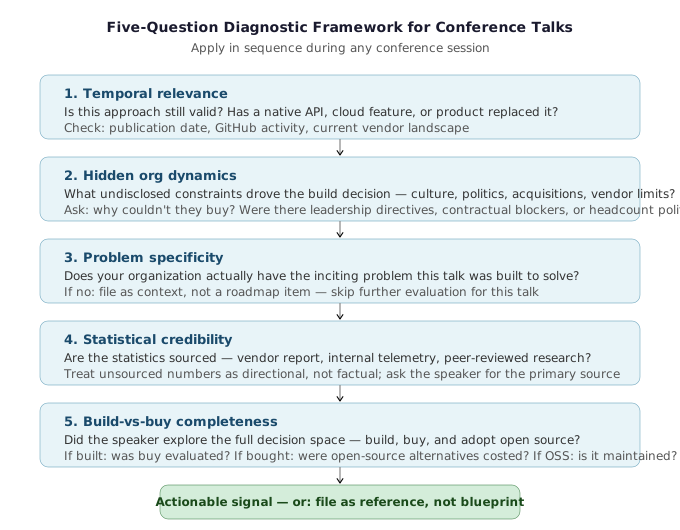
When evaluating conference talk advice, the gap between inspiration and actionable signal comes down to the questions you ask in real time. Ramy McCarthy’s talk at fwd:cloudsec distills a reusable diagnostic into five distinct lenses — each targeting a category of omission that speakers systematically leave out. Applied together, these questions transform passive conference attendance into active critical thinking in infosec.
1. Is This Still Relevant? Check the Timestamp
The first question to run on any talk is temporal: when was this approach designed, and does that still hold?
Cloud security moves fast. APIs that didn’t exist two years ago now replace entire homegrown tools. The most pointed example: Netflix built Repo Kid, an IAM tool that relied on screen-scraping AWS Access Advisor[2] to approximate IAM usage data. That was a clever workaround — in 2018. AWS subsequently released Access Advisor APIs natively, making the entire approach obsolete.
The same logic applies to open-source projects. Before treating a tool mentioned in a talk as the solution to your problem, check whether the GitHub repo is still maintained. In the Yubikey break-glass example, the implementation pointed to an open-source PKI component — and whether that component is still viable is a question the talk itself cannot answer for you.
Temporal staleness is invisible on stage because speakers give talks when something is fresh. They rarely return to the podium three years later to report that the system was decommissioned or that a first-party product has since replaced it.
2. What Organizational Dynamics Are Hidden?
The second lens targets the hidden organizational context behind build decisions. A large proportion of conference talks describe internal tools, custom pipelines, or bespoke programs — and almost none of them disclose the real reason the team chose to build rather than buy.
McCarthy enumerates the actual drivers that rarely appear in talks:
- An organizational culture that treats engineering as inherently superior to buying
- Existing headcount that needed a project to justify itself
- Leadership directives that ruled out certain vendors for political, contractual, or relationship reasons
- Acquisitions and M&A activity that locked the company into a multicloud architecture they wouldn’t have chosen otherwise
- Vendor kickbacks or negotiated discounts that made a specific product artificially attractive
The multicloud joys example from the talk captures this cleanly: a speaker presenting the resiliency benefits of multicloud may be describing a constraint — not a choice. Their architecture may be the product of acquisitions, not an engineering ideal you should replicate.
When you hear a build story, the missing question is always: why couldn’t they buy? The answer is usually more mundane than the technical content suggests — and often disqualifies the approach for your context.
3. Does Your Organization Have the Same Inciting Problem?
Every conference talk starts from a problem. The speaker experienced friction, saw a risk materialize, or encountered a gap — and then built something to address it. The talk presents the solution. The problem gets less stage time.
This asymmetry is the source of one of the most common and expensive mistakes practitioners make: cargo-culting a solution to a problem they don’t actually have.
McCarthy frames this as a concrete risk: you walk into a conference focused on cloud security, hear a compelling talk on distributed lambda-based inventory collection, and leave thinking your team needs that system. But if your organization isn’t running a massive distributed cloud footprint with dozens of accounts and no centralized inventory capability, the talk’s inciting problem is not your inciting problem.
The diagnostic question to run in real time: Does my organization actually face the problem this talk was built to solve? If the answer is no, the technical content is interesting but not actionable. File it as context. Don’t file it as a roadmap item.
This is why entering every conference with a problem list is structural, not motivational. A pre-defined problem list functions as a filter: it tells you which talks are answering questions you’re already asking, and which are introducing new questions your organization has no reason to prioritize.
4. Are the Statistics Sourced and Credible?
Security talks frequently include statistics — breach percentages, root cause breakdowns, incident frequency data — and the sourcing is almost never disclosed on the slide.
McCarthy calls out this pattern explicitly: when a speaker says “66% of cloud incidents are caused by leaked IAM keys,” the natural follow-up questions are:
- Is this from an AWS threat report? From internal telemetry? From news coverage of public incidents?
- What’s the sample size and selection bias?
- Is this vendor data presented in a context that benefits the vendor’s product category?
The marketing-substance matrix concept from the talk provides a practical heuristic: estimate what percentage of a talk is marketing versus technically useful content. Sponsor talks are a yellow flag — they didn’t go through a CFP process, which means the content selection was driven by a different incentive structure than a peer-reviewed practitioner talk.
When a number appears without a primary source citation, treat it as directional, not factual. This is especially important when that statistic is being used to justify a tooling investment or program change.
5. Is the Build-vs-Buy Framing Complete?
The fifth lens is the one most practitioners miss because it’s a question about what the talk doesn’t cover, not what it does.
A talk that compares three open-source tools and explains why the team chose one of them has answered a narrow question: which open-source tool. It has not answered whether open-source was the right category of solution at all. Similarly, a talk about building a custom CSPM may compare build options without asking whether an existing commercial CSPM would have been cheaper, faster, and less maintenance-intensive.
McCarthy identifies this as a structural blind spot in practitioner talks: speakers tend to present decisions along the axis they explored, not the full decision space. The build/buy/adopt framework collapses into whichever option was chosen, and alternatives outside that path get no airtime.
The diagnostic questions to run:
- If they built it: Did they genuinely evaluate existing products? Were there contractual, political, or cultural reasons they couldn’t buy?
- If they bought it: Did they evaluate open-source alternatives? Was cost actually modeled?
- If they adopted an open-source project: Is the project maintained? Does it match their scale, or are they underselling the integration work?
Putting the Framework Together
Applied in sequence, these five questions create a conference talk evaluation checklist that filters out noise before it becomes a roadmap item:
- Temporal relevance — Is the approach still valid, or has the landscape moved?
- Hidden org dynamics — What undisclosed constraints drove the decision?
- Problem specificity — Does your org actually have this problem?
- Statistical credibility — Are claims sourced, or is this vendor-adjacent data?
- Build-vs-buy completeness — Did the speaker explore the full decision space?
None of these questions require confronting the speaker. They’re real-time filters you run in the room. And per McCarthy, speakers want you to ask them afterward — most of the context that gets cut from the talk for time or confidentiality reasons is context speakers are happy to provide in a hallway conversation.
Actionable Takeaways
- Before your next conference, write a short problem list — 3 to 5 specific challenges your team is actively working through. Use this list as a real-time filter during talks: if a talk isn't answering a question already on your list, treat it as context rather than a roadmap item.
- When a talk presents statistics without citing a primary source (vendor report, internal telemetry, peer-reviewed research), apply a skepticism discount before using that data to justify decisions. Ask the speaker after the talk where the number came from.
- For every build talk, identify the unstated reason they couldn't buy. If that reason doesn't apply to your organization, re-evaluate whether the technical content is actually applicable — or whether a commercial or open-source alternative already solves the problem at lower cost.
Common Pitfalls
- Treating a conference talk's solution as organization-agnostic. The most common and expensive mistake practitioners make is hearing a compelling technical solution and assuming it applies universally. Every talk is rooted in a specific organizational context — distributed teams, account sprawl, contractual constraints, existing infrastructure — that the speaker had no incentive to make the focus. If you skip the diagnostic questions, you risk allocating engineering cycles to solving a problem your org doesn't have.
- Assuming that because a talk is at a practitioner conference, it has already passed the "applicable to me" bar. Even at highly curated conferences like fwd:cloudsec, talks describe moments in time, not durable solutions. A system that was correct when the talk was given may have been deprecated, replaced by a first-party feature, or quietly abandoned when the speaker left the company. Always check temporal relevance before treating content as current.
What Good Contextual Disclosure Looks Like
Most conference talks describe a destination. The best ones show the road — including the wrong turns. Understanding what good contextual disclosure actually looks like is the key to recognizing quality knowledge sharing when you encounter it, and to demanding more of it from the field.
The Multi-Year Retrospective Model
The gold standard for practitioner talks is the multi-year retrospective — a format that shows not just what was built, but how decisions evolved over time under real organizational pressure.
Ramy McCarthy highlights two examples from his own community that demonstrate this well.
The first is a talk from Will and Devon at HashiCorp on scaling IAM in a SaaS company over five to six years. Rather than presenting a polished final state, the talk walked through the sequence of decisions that seemed correct at each moment in time:
- Implementing granular roles
- Adopting least-privilege as a principle
- Rolling back toward just-in-time access
- Moving to resource-based access
- Evolving toward intent-based access
What makes this valuable is not the destination — it’s the honest sequencing. Each decision was right when it was made, given what the organization knew and needed at that moment. Showing those bumps explicitly allows the audience to understand why each evolution happened, not just what changed.
The second example is Jacob Salasie’s talk on scaling an AppSec program, where he discusses the lifecycle of building a partnership program and the things he did that were right at the time — but which he had to change later because he stayed long enough to see them fail. This is a form of disclosure most speakers are unwilling to make: acknowledging that a celebrated decision turned out to be wrong.
What These Talks Have in Common
Both examples share a set of structural properties that separate them from the typical “here’s the cool thing we built” format:
1. Temporal honesty. They make explicit that decisions were made at a specific point in time, under specific constraints. The audience is not left to assume the final state is the permanent recommendation.
2. Failure disclosure. Both speakers were willing to describe things that didn’t work — not as footnotes, but as a central part of the narrative. This requires trust in the audience and a willingness to look fallible, which is precisely what most speakers avoid.
3. Organizational context as a first-class concern. The talks don’t treat the technical architecture as self-contained. The organizational dynamics — team size, company stage, changing requirements — are treated as inputs to the technical decisions, not as background noise.
4. Long enough horizon to show outcomes. These retrospectives work because the speakers stuck around long enough to see what happened. This contrasts sharply with talks given immediately after something is shipped — when there’s no data on whether it delivered value.
The One-Slide Rule for Speakers
McCarthy offers a concrete, minimal intervention for speakers who want to improve their contextual disclosure without restructuring their entire talk: a single slide at the top that tells the audience what they need to know about the speaker’s organizational context before the technical content begins.
The example he gives is Chris’s AntiP blog post and talk — a genuinely cool distributed lambda-based inventory system — which does not mention any of the organizational reasons it was built: the cost considerations, the distributed team structure, the specific requirements that made the architecture necessary at the time. A single slide listing two or three of those factors would fundamentally change how the audience evaluates the rest of the content.
A companion technique is to close with a set of questions the audience should ask after the talk — questions whose answers can’t be given on record or live, but which the speaker is happy to discuss in the hallway. This creates a permission structure for more honest disclosure in low-stakes contexts. Examples might include:
- “Ask me about the engineering effort to maintain this system.”
- “Ask me about the real cost.”
- “Ask me whether we’d build it the same way today.”
This framing acknowledges that some context is genuinely sensitive or legally constrained — while still signaling to the audience that more context exists and inviting them to seek it out.
Recognizing Good Disclosure in the Wild
For attendees, the practical skill is learning to recognize and reward talks that do this well. Markers of strong contextual disclosure include:
- The speaker explicitly names the organizational conditions that drove the decision (team size, budget constraints, acquisition history, vendor relationships).
- The talk covers a multi-year arc rather than a single point in time.
- Failure or reversal is mentioned without being buried — it’s presented as informative, not embarrassing.
- The speaker acknowledges what the approach would not work for, or who the audience is not.
- Statistics are sourced, not asserted. When data is cited, the speaker names where it comes from and acknowledges its limits.
The absence of these markers doesn’t mean a talk is bad — it may reflect legal constraints or time limits — but it should activate your critical evaluation mode rather than passive consumption.
Why This Matters for How to Learn from Security Conference Talks
The structural problem McCarthy identifies is that security gets harder when practitioners are repeatedly pointed toward complex systems that don’t fit their context. When every talk presents a clean success story with hidden predicates, the field collectively re-learns the same expensive lessons — wasted engineering cycles, deprecated tools, and unmaintainable systems left behind when speakers leave their companies.
Good contextual disclosure is the antidote. It respects the audience’s ability to handle complexity, it extends the useful lifespan of the knowledge shared, and it builds the kind of trust that makes hallway conversations — where the real context lives — more likely to happen.
Actionable Takeaways
- When evaluating talks, actively look for temporal framing: does the speaker tell you when a decision was made and what the conditions were at that time? If not, apply that filter yourself — treat the content as a snapshot, not a recommendation.
- If you are a speaker, add one slide at the start of any build or program talk that lists the two or three organizational conditions that made your approach possible (team size, budget class, existing infrastructure). Close with one or two questions you are happy to answer off the record to give the audience a path to fuller context.
- Prioritize multi-year retrospectives over point-in-time success stories when deciding which talks to go deeper on. If a speaker has been living with a system long enough to describe what broke and what they changed, their content will transfer to your environment with far less cargo-culting risk.
Common Pitfalls
- Treating polished, single-point-in-time success stories as reusable blueprints. A talk that shows only the final architecture — without the organizational context, cost realities, or evolution path — is a snapshot presented as a recommendation. Engineers who adopt it wholesale risk building systems their organization cannot sustain or that don't match their actual risk profile.
- Giving a talk immediately after shipping something, before any outcome data exists. Speakers who share new work before they've seen whether it delivers value are, as McCarthy puts it, "excited they did it" — not reporting results. The audience receives a system description without any signal about whether it was worth building.
How to Attend and Give Better Security Talks
Stop Treating Conferences Like a Buffet — Come With a Problem List
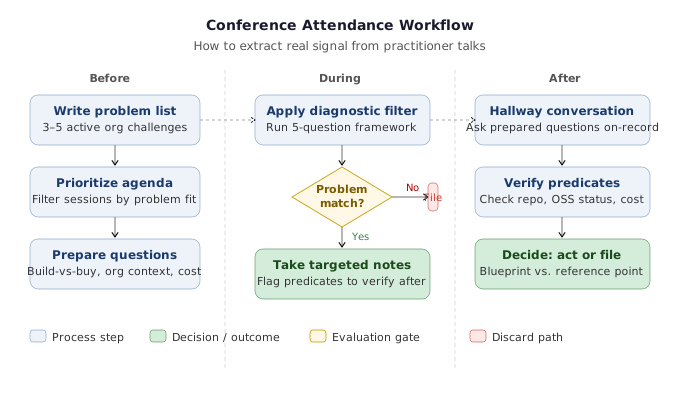
The most important shift you can make in how to learn from security conference talks is to arrive at a conference already knowing what you need to solve. If you walk into a practitioner conference like fwd:cloudsec and treat it as a buffet of things to bring back to your security operations team, you will leave with a chaotic mix of multicloud identity architectures, OCI vulnerabilities, and custom PKI implementations — none of which connect to any problem your organization actually has.
Come in with specific, prioritized concerns. If you’re worried about IAM sprawl or need to rethink how you handle cloud inventory, orient your schedule around those themes. Use the agenda to filter, not to browse. Then use the talks you attend as targeted answers to your pre-existing questions rather than letting the talks lead you by the nose.
This approach multiplies the value of every session. Instead of passively absorbing a stream of polished presentations, you’re actively interrogating each talk for relevance to your situation — which also primes you to ask better follow-up questions.
Connect With Speakers for the Off-Record Context
The most valuable information from any conference talk often doesn’t make it into the slides. Speakers are constrained on stage — by recording, by employer expectations, by time — but many of those constraints disappear in a hallway conversation or over a happy hour.
Write your list of questions before the talk ends. Come out of every session knowing exactly what you want to follow up on:
- “Did you seriously consider buying a solution here, or was build always the direction?”
- “That open-source project you referenced — I just checked and it’s deprecated on GitHub. Is this still relevant?”
- “How much engineering effort does this system actually require to maintain?”
- “You mentioned the system worked well — did it survive past the first year? Did it outlast the team that built it?”
Speakers are not bad actors. They want to give you the full picture — they just can’t always do it on stage. Most are genuinely happy to answer direct questions afterward. The speaker’s intent in omitting context isn’t to mislead you; it’s that they’re hoping you’ll come ask them the question so they can provide what couldn’t be said publicly.
The number of post-talk conversations that will transform a “cool architecture I might copy” into “interesting approach that clearly doesn’t apply to us” is substantial. That filtering is worth more than attending additional sessions.
For Speakers: Build In One Slide of Organizational Why
If you are a speaker — and given that this is a practitioner conference, many of you are or will be — the single highest-leverage change you can make is adding one slide that provides the organizational context your audience needs to evaluate your approach.
You don’t need to disclose sensitive business information. You need to answer these questions before launching into the technical solution:
- Why did we build this instead of buying?
- What constraints drove this decision? (cost, architecture, headcount, distrust of vendors?)
- Who is this actually useful for — and who should probably not copy it?
A single slide with that context can save engineers in the audience from spending three months on a project that doesn’t fit their environment. That’s the real service to the community.
You can also add a closing slide that suggests questions to ask you after the talk — things you’re happy to discuss that can’t be said on record. This gives the audience a path to the real information without forcing you to overshare on stage. Something like: “Ask me about the engineering cost of this system. Ask me about what we’d do differently if we started today.”
Give Talks That Show the Bumps, Not Just the Destination
The best practitioner talks don’t just show a technical achievement — they show the journey, including the parts that didn’t work. A multi-year retrospective is almost always more valuable than a snapshot of what you shipped last quarter.
If you have something that’s been running for four years and survived organizational change, a team turnover, and a vendor evaluation, that’s a far more honest and useful talk than a talk about something you finished three months ago and haven’t yet had to maintain.
Be willing to be vulnerable. Talk about:
- Decisions that were right at the time but required rethinking later
- Systems that got torn down or replaced — and why
- Things you’d approach differently if starting over
This is exactly what separates genuinely useful community knowledge from polished vendor pitches in practitioner clothing. Security is hard, and it gets harder when practitioners give each other misleadingly confident advice about building complex systems — only for the audience to relearn the same lessons independently a year later.
The CFP process rewards depth. Detailed outlines with clear takeaways, honest scoping of who the talk applies to, and specific problem statements all help reviewers and audiences alike. If you’re concerned about overpromising, pull your talk track into the CFP submission itself — the more you surface up front, the less likely you are to disappoint the audience you specifically want to reach.
Actionable Takeaways
- Before attending any conference, write a list of 3–5 specific problems or questions your organization is currently facing. Use that list to prioritize which sessions to attend and to generate targeted follow-up questions for speakers afterward — treating talks as answers rather than inspiration.
- After every talk you plan to act on, request 10 minutes with the speaker during a break or happy hour. Come with written questions about organizational context, build-vs-buy rationale, long-term system health, and any dependencies the talk implied but didn't address.
- If you are a speaker, add one slide before your technical deep-dive that states the organizational constraints that drove your approach — budget limits, team size, vendor trust issues, architectural predicates. End with a list of questions you're happy to answer off the record, so attendees know how to get the real context.
Common Pitfalls
- Attending a conference as a passive discovery exercise — collecting a mix of talks to bring back to your team as a list of new initiatives — without filtering for relevance to your current problems. This leads to cargo-culting architectures that were built for entirely different organizational contexts, wasting engineering cycles on systems that won't deliver value.
- Giving a talk immediately after completing a system, before you know whether it worked. Talks delivered before a system has been maintained through at least one major organizational change — team turnover, budget cut, vendor reassessment — systematically omit the most important information an audience needs to evaluate whether to replicate the approach.
Conclusion
Security conference talks are structural artifacts of the environments that produce them — shaped by NDAs, reputational incentives, time pressure, and the social dynamics of wanting to look competent on stage. The omissions are predictable, and once you understand why they happen, you can compensate for them in real time.
The five-question diagnostic framework — temporal relevance, hidden org dynamics, inciting problem specificity, statistical credibility, and build-vs-buy completeness — gives practitioners a reusable filter that works across any conference, any talk format, and any technical domain. It doesn’t require confronting speakers; it requires asking better questions before you take notes back to your team.
The deeper shift is cultural: treating conference talks as starting points for inquiry rather than authoritative recommendations. The hallway conversation after the session — where the NDA loosens, the recording is off, and the speaker can finally answer the question that didn’t make it onto a slide — is often where the most valuable knowledge transfer actually happens.
If you found this useful, explore related discussions on security operations decision-making, the trade-offs in build vs buy decisions in security, and how to develop stronger risk-based prioritization frameworks for your team.
References & Tools
- AWS Lambda — Serverless compute service used in the AntiP distributed inventory system example as the per-account collection mechanism. ↩
- AWS Access Advisor — IAM feature that shows service access data; originally lacked APIs, prompting Netflix's Repo Kid screen-scraping workaround — now provides native API access, making the workaround obsolete. ↩
Questions from the audience
Related deep dives
Glass-Box Security: Operationalizing Mechanistic Interpretability | [un]prompted 2026
Detecting GenAI Threats at Scale with YARA-Like Semantic Rules
AI Agent Detection Engineering